By Curity Ogada
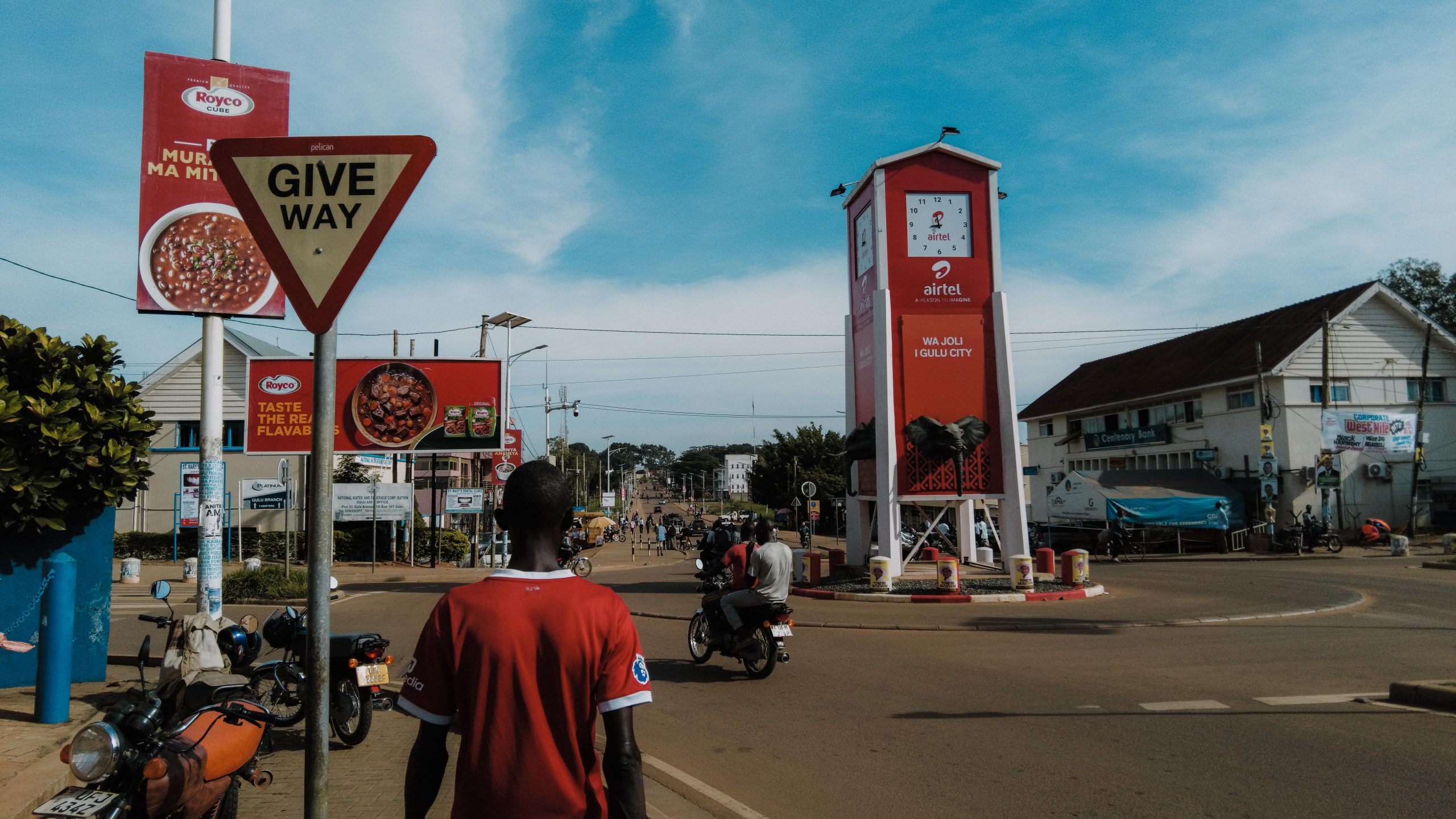
Northern Uganda is the country’s best-kept secret. Gulu is at the center of this treasure, a city so vibrant it rarely sleeps, a city that has preserved its culture, its local language, and, not to mention, its rich range of ancestral foods. Gulu City is one of the fastest-growing cities in Uganda; industrialization and innovation seem to be growing speedily.
Northern Uganda has preserved its source of livelihood: they farm. According to research published by Science Direct, the Acholi Sub-region holds over forty percent of Uganda’s fertile arable land.
Uganda is also among the most vulnerable countries to the devastating impacts of climate change. According to research from Science Direct, a dataset of six hundred randomly selected farmers across Northern Uganda found that droughts, increased temperature, pests and diseases, land degradation, and poor socioeconomic conditions are the main determinants of climate change. This means that the region has faced the brunt of it, ranging from unpredictable seasons, extreme heat and drought, and unprecedented long rains.
All these conditions can affect agricultural yields, leading to losses. This situation has, for many years now, led mostly young people to run from farming and go for office jobs where a salary, no matter how meager, is assured at the end of the month.
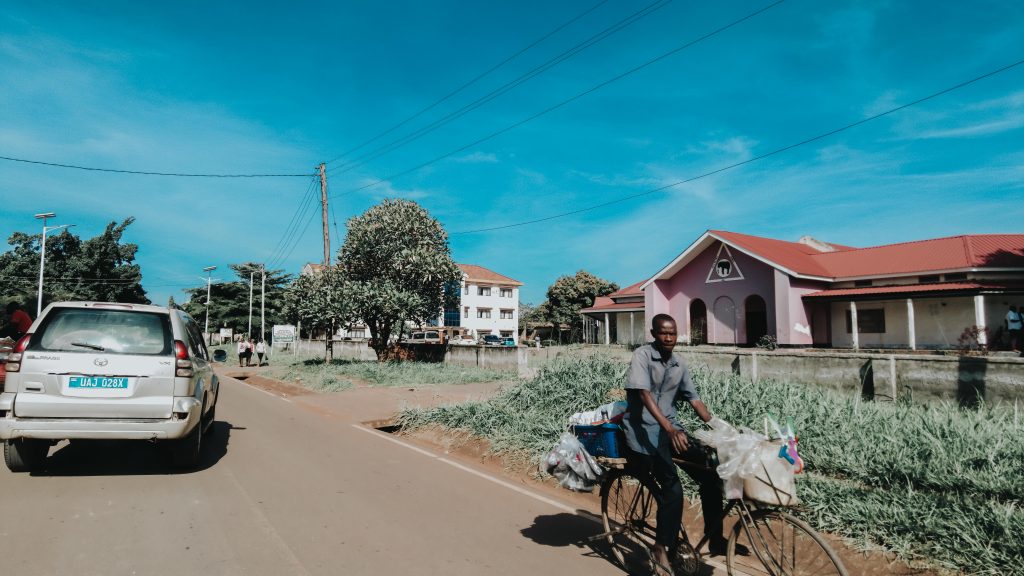
Photo credit: Curity Ogada
Gulu has not been spared this fate. Farms lie bare or underused as most youths run from them to secure nine-to-five alternatives for assured sources of income to feed their families.
However, most youths across East Africa have had to face the harsh realities of limited resources and little to no employment opportunities, leading to engagement in non-developmental activities, crime, or micro earnings from hard labor. Ugandan youths share a similar plight.
In the thick of experiencing these discouraging effects of climate change, resilient minds have been forged under the pressure to give in. Alternatives through research, education, and resources have been tested and proven to work. Perceptions are changing, and farming is being looked at with much clearer and sober minds as the range of climate change continues to ravage the agricultural sector.
What is the difference? There is a bridging of the knowledge gap. Just a few kilometers from the busy city center, in the peri-urban peripheries of Gulu City, there are young farmers already driving change with acquired knowledge, skills, and innovative ideas to benefit big time from agriculture. However, in the same setting, older farmers, even though facing the devastating effects of climate change, are adapting to changing times using their ancient skills, which they have now modified over time to benefit them.
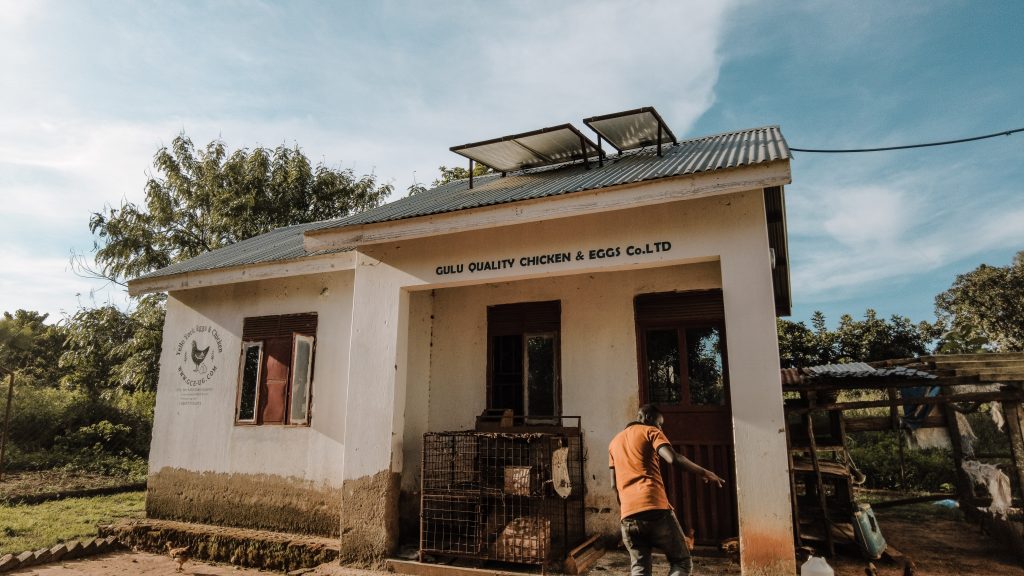
Photo credit: Curity Ogada
Solomon Rackara, a young man who just turned 35, is a beaming mind of great innovations and ideas. He has set his farm in the outskirts of Gulu City, just thirteen kilometers away from the bustling center. In the quiet of his ancestral home, he has set up a thirteen-meter by fourteen-meter facility for his poultry, pigs, and rabbit rearing. Just away from this setup, he has converted extra acres for maize, potatoes, fruits, and vegetable farming.
“I plant maize, not for family consumption but for my livestock. I have built a cycle around the farm that works effectively and efficiently,” Solomon says.
Rackara has loved agriculture from a young age, and his parents supported his dreams. Even though he graduated with a bachelor’s degree in Information and Technology, he has always kept his farming interest aflame. Now married with three kids, Solomon has done tremendously well in farming.
“I noted the effects of climate change when I would lose so much. I would plant, the rains would be late, it would be time for harvest and the rains would come, but I never gave up.”
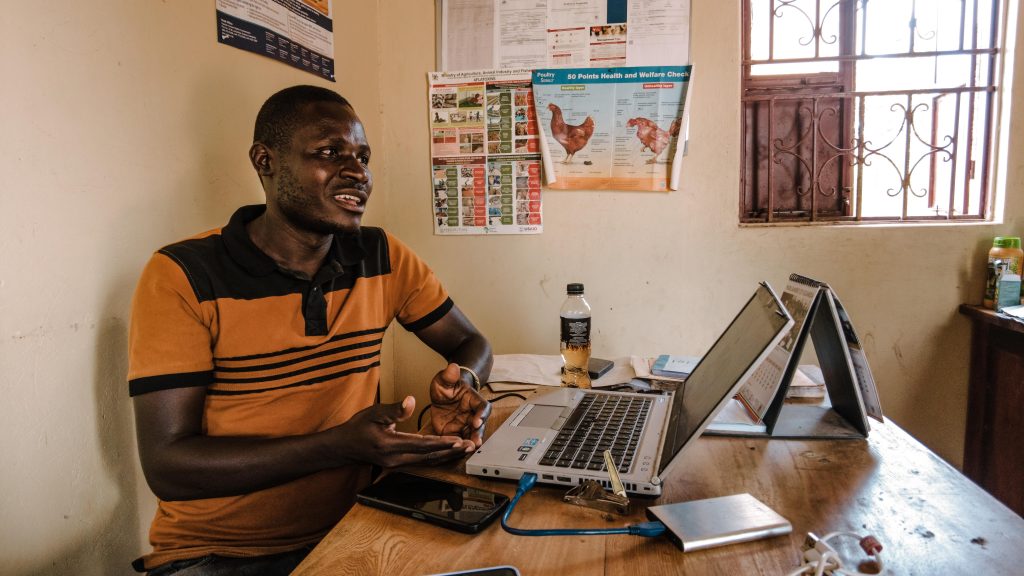
Photo credit: Curity Ogada
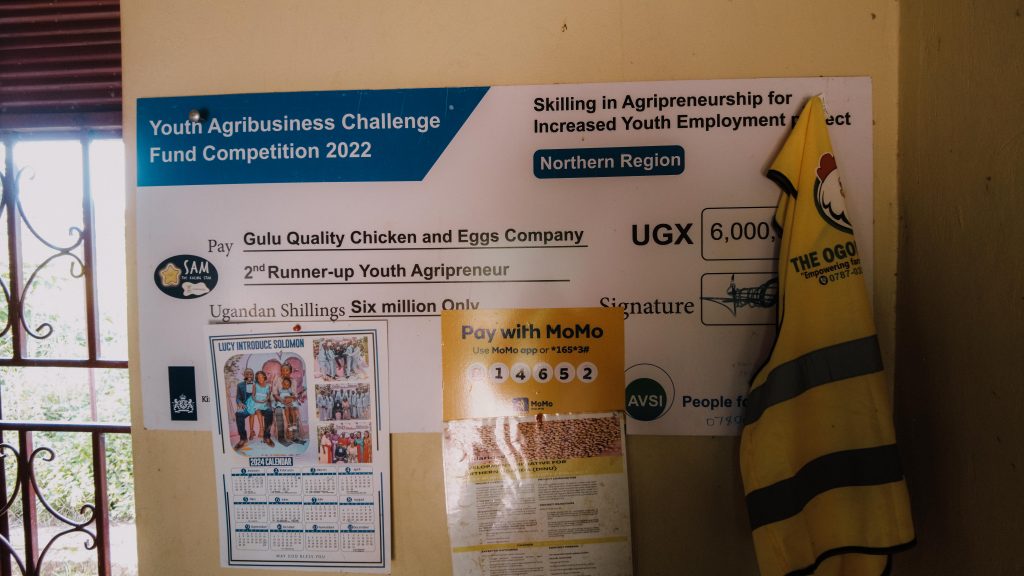
Photo credits: Curity Ogada
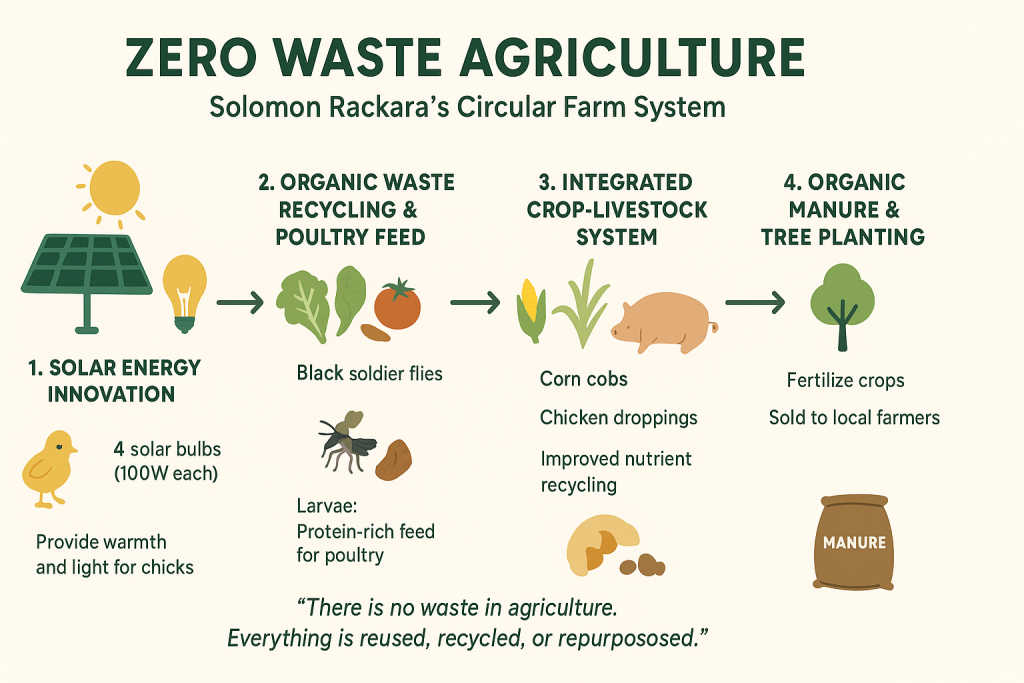
Rackara, like most poultry farmers, does not use charcoal to breed his chicks. Having participated in a youth agribusiness challenge with innovation, for his first innovation, he made a system that converts green solar power to heat and then to light. Around the farm, he has four solar bulbs, each one hundred watts, which are very powerful and heat up pretty fast. His second innovation was the purchase of organic waste from local markets, like tomatoes, cabbage leaves, and avocados.
He would put them in a dark corner until they rotted, and the rot turned into maggots. He then kept them in timbers until they became flies (black soldier flies). They are not harmful and are such good sources of protein for poultry and even for humans in their larval form (rich in iron). This really intensifies the growth of chicks, so instead of keeping them for two and a half months, Rackara keeps them for one month and they are already two kilograms, thanks to the black soldier flies’ benefits. The decomposition was still also a benefit to his crops as he got manure from the same innovation.
“There is no waste in Agriculture. So I started doing my research: how do I recycle everything?” says Rackara.
His third innovation was farming maize for his poultry and pigs. When the maize was ready, he would take corn for the chicken and even farm soya beans and add it as their supplement. Through his own research, he found he could use the maize covering and leaves as bedding for his pigs. With the maize itself, he divides his eight acres: half for chickens and the other half for pigs. He grinds the cobs to fine flour as food for his pigs, making his own formulation of a nutrient-rich diet for his pigs.
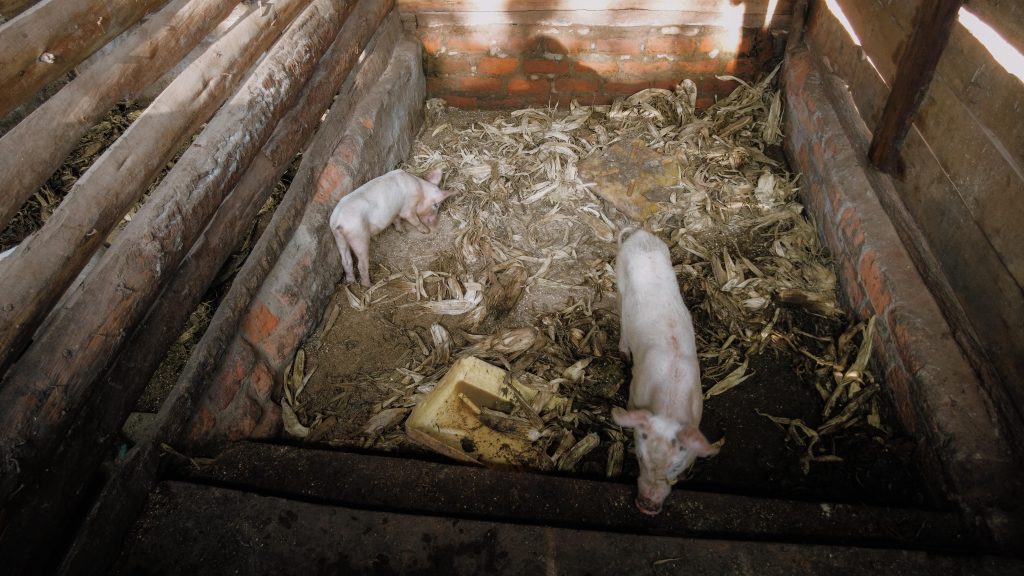
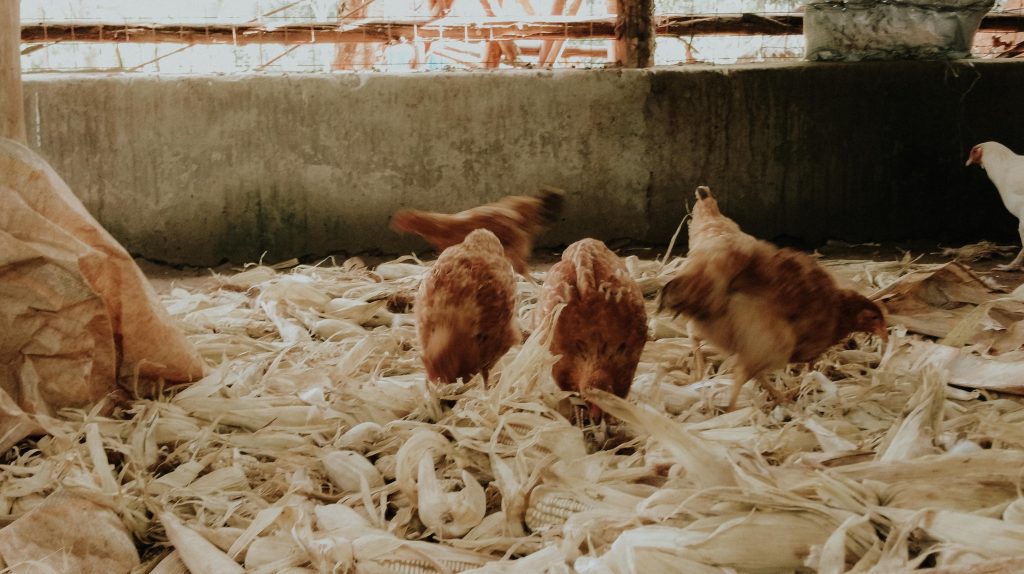
Photo credit: Curity Ogada
He also learnt that his chicken droppings are such good and nutritious food for pigs, so he collects their droppings and also adds them as part of his pigs’ diets. He feeds them this with lots of water. They take like eight liters of water, and this makes them grow so fast.
The droppings from his pigs he takes to decompose into organic manure in his pit. When there is rain, the decomposition (breakdown to release gas and heat) takes just two weeks, but longer when it’s not raining. He uses this manure to feed back into his farm and sells the extra to local farmers who farm vegetables in his community. Recently, he is getting large orders, selling in bulk at UGX 80,000 a sack (2.29 dollars).
Once in a while, the pigs still get ammonia reactions from the droppings. So, instead of spraying the IMO (Indigenous Microorganisms) to break down the ammonia into harmless and smell-less food, which the pigs eat since it irritates them less, he has opted to plant more trees. He plants more trees because trees will automatically replace the ammonia and carbon dioxide with oxygen. So, other than making the structure aerated, he has invested in trees that give oxygen and the pigs hardly get the smell.
“I also brought on board rabbits. I sell everything in them, starting from their urine, which I collect using a gutter. The floor I have made is stainless steel. I sell the urine to vegetable and fruit farmers. A rabbit’s urine is so rich nutrients like nitrogen, potassium and phosphorus that boosts the production of vegetables. Because of its irritating nature it scares away all insects, so one does not need to buy an insecticide. The urine is also organic; no chemicals.
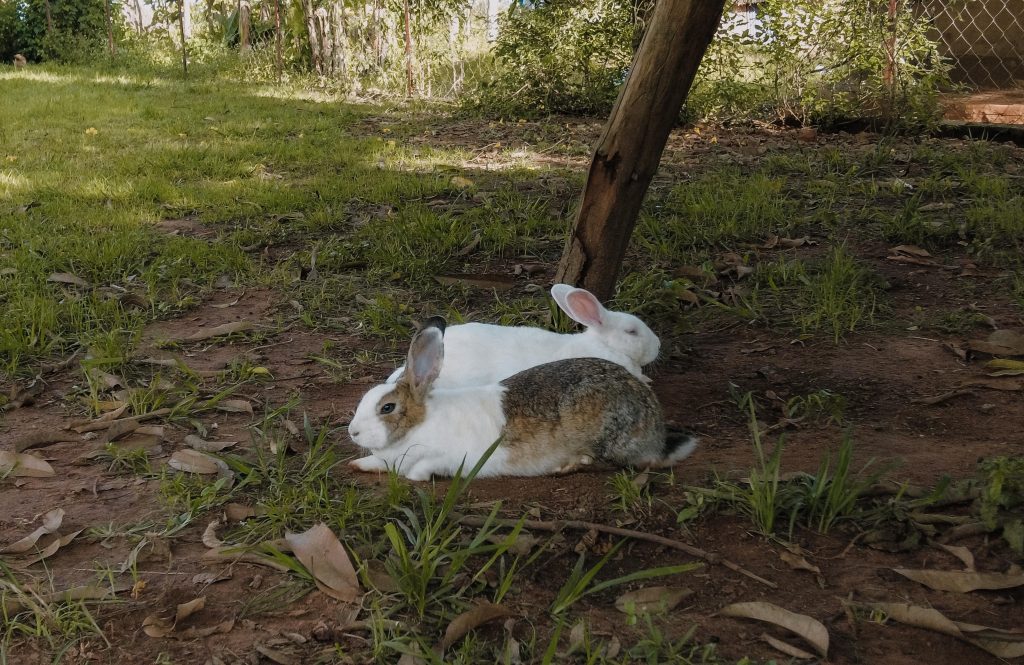
Photo credits: Curity Ogada
If you spray it on a fruit tree like avocado, or even a cassava farm, no animal or insect can step inside. It has a very pungent smell, and the magic is, the trees grow really fast with rabbit’s urine. The rabbit’s droppings are a primary feed for fish, so I collect them and sell them to cage fish farmers with a kilo costing UGX 1000 (0.29USD). For the rabbit’s hair, we use it to treat burns. In just two days of applying the hair on an open wound, it dries up. And then finally, the meat. There is no better white meat than that of a rabbit. Apart from being such a delicacy, it helps to reduce high blood pressure.
My grandmother can attest to that. We even verified this through pressure self-testers. When she eats the meat, the pressure goes down and she does not need the medicine,” says Rackara with pride.
Bridging the Knowledge Gap in Communities
Rackara has spread this knowledge like wildfire. Being also a community leader, he has shared his knowledge across different parishes in Gulu, teaching farmers this zero waste technique. He has also been lucky to have gotten support from the Government of Germany on upscaling different skills in Agriculture, and next year he is going to learn more on Climate Change.
He says climate change is fueled by how we farm, how we settle (land use), industrialization, and interfering with our tree cover. Farmers need to adjust their practices, be more innovative, reduce the use of acidic products or chemicals, reduce vast burning, and use of very old vehicles, which are also a danger to human health other than the climate itself.
“From the year 2016-2019, I have done several trainings and demonstrations in Northern Uganda on climate-smart agriculture across forty-two parishes in Uganda covering nine districts, and even linked farmers to markets where they can sell their produce. We have an outgrowers group where we share these skills, even to local and small vegetable farmers around this community.”
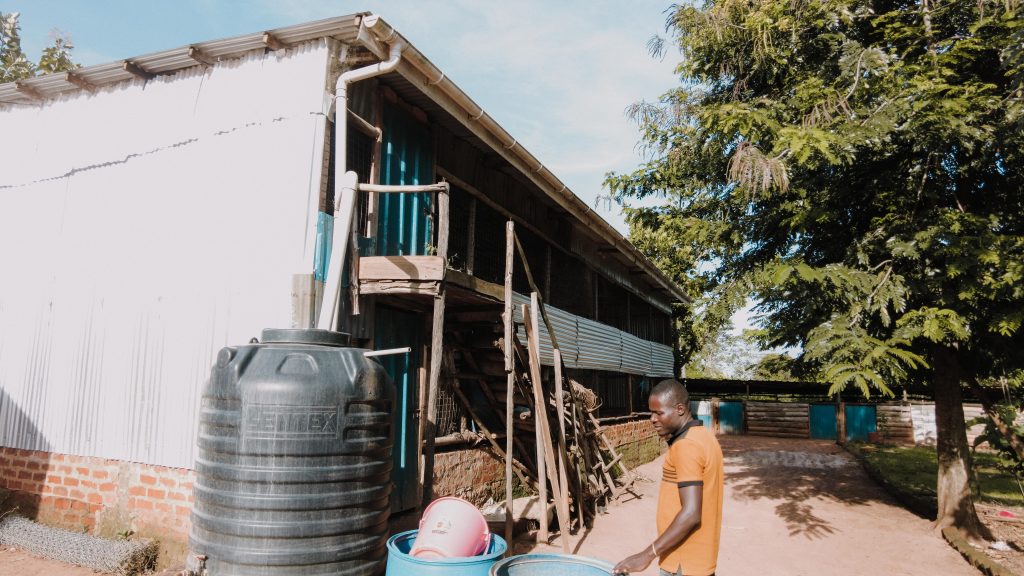
Photo credits: Curity Ogada
Policy Gaps in Agriculture and Climate Smart Agriculture
Solomon says there is a big gap, especially arising from the demise of cooperatives that used to help in bulk production and sale of farm produce. The gap is worse in the peri urban centers, which in the local government service structures lack urban agricultural officers to support urban farmers on how to produce, cultivate, and use techniques to beat climate change. But even in the thick of rural areas, the agricultural officers are not in touch with grassroots communities, and this intensifies the knowledge gap, as they do not go to the fields and are more in offices and workshops than the farms themselves. Therefore, farmers lack a person who communicates these technicalities in a language they can understand.
“The government is not reaching out to farmers but expecting from farmers,” says Solomon Rackara.
There is a forum that helps local farmers to engage with the government, and it is called Needs Assessment Prioritization, where parish chiefs and town agents go to the communities and collect their needs. The problem is the communities lack someone to sensitize them on what to prioritize when sharing their needs, and normally it ends up being an imposed need like electricity and roads, and not tabling their daily needs attached to environmental and farming issues. This narrows down to the same officers who do not interact with the farmers to enlighten them on what to share during these needs calls from agents.
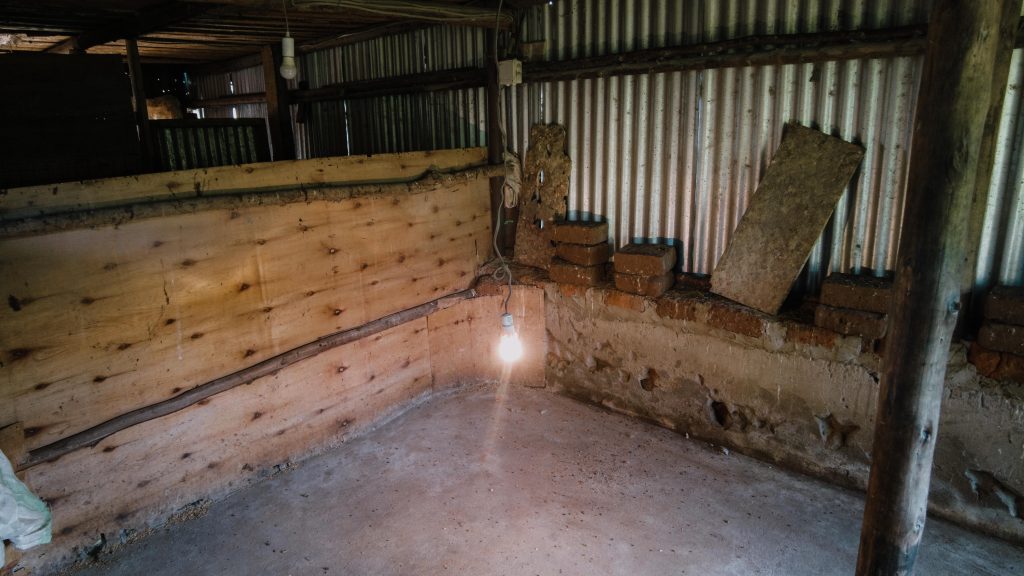
Photo credits: Curity Ogada
“The problem is not that you are sleeping hungry. The problem is that you are not working to help your hunger level. People are not told the cause of their symptoms. If it’s well done, then during budget allocation, their needs can actually reach budget allocation for their farm ambitions and challenges,” says Rackara.
Uganda has very wonderful policies that are currently not being put to use, even when it comes to the environment. There is a policy for cutting one tree and planting ten, but people cut ten and plant none. Uganda has all the policies. There is a need for good regulations, and the media should also come in and help in advocacy.
“Youths are looking for quick gains, and that’s why they turn to gambling and betting and following political waves where they get small handouts. They hardly think they may live ten or twenty years. This is all in the mind, and youths need to invest in as many forums as possible so that they change their perception. Youths should know that tomorrow belongs to them, not today. We do not do much for the world; we only contribute to the world, and that means your time also passes. It is better to be productive than beg, especially if they have lands lying around in their rural homes or have the power to lease land to make it productive,” concludes Rackara.
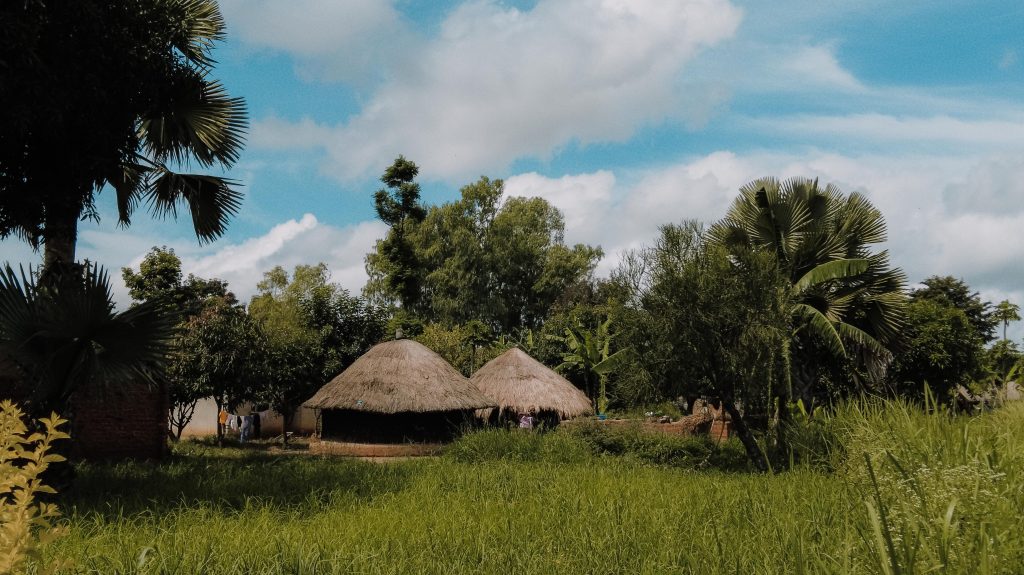
Photo credits: Curity Ogada
Knowledge-Based Farming in Semi-Urban Setups, Reducing Unemployment
Lakot Flavia is one brave young woman from Lawiyadul, a parish in the Laroo Pece Division of Gulu City, Uganda, who decided to be productive in her youth. At just 38 years old, the youngest of a family of five, she has a degree in development studies with a certificate in accounting.
Currently, she does social work with Urbaners Hope. However, because of her untamed passion for farming, she opted to work part-time and devote the rest of her time to it. She does poultry rearing, modern farming near her home to farm okra, and also manages another farm in Chwero, a sub-county in Gulu where she plants matooke (plantains), yams, and even more poultry on a larger scale.
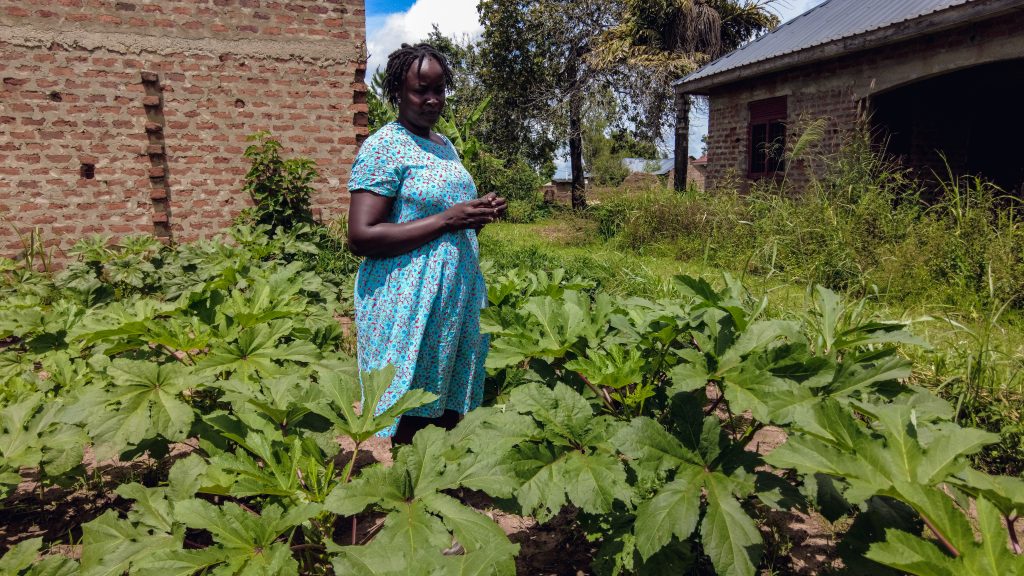
Photo credits: Curity Ogada
There was a season when Flavia planted maize and beans in her semi-garden of half an acre, and it rained when the plants did not need rain, and she lost all her produce. She therefore decided to time the September and October climate, which normally does not receive too much rain, to plant okra instead.
The moment okra starts flowering, even if the rains become unpredictable, it will still flourish and be ready for harvest. And, if it happens to shine too much, there is a product called VegiMax Organic Fertilizer that helps to regulate the plant’s growth. It helps to protect the plant from the adverse effects of too much heat. A spray can protect fruits and vegetables for two weeks, just in time for an okra to flower in harsh weather.
Flavia realized she made more from farming than working a nine-to-five job. She can make 3,000,000 UGX (858 USD) from her half-acre okra farm in just less than three months. This is a salary almost equivalent to a managerial position in a white collar setting. And this is besides the poultry, the matooke, and the yams. This is just a small farm beside her home where she bags and earns a decent living in quite a short span by using learned and acquired knowledge to beat climate change effects.
“I have so many who come for consultation, especially those affected by wilt (a plant dries up, weakens due to a virus in the soil). By using cement and mixing it with soda ash, dropping one spoon of the mix into the soil helps to kill the wilt virus in the soil (communally proven, but she says it has worked and she got this skill from other farmers),” says Flavia.
She also affirms that currently they have no working official forum that can help to share these kinds of skills with other farmers, but the forum, she says, could be very good, especially for farmers who have no idea how to go about a particular virus. It could also help to elevate certain practices through knowledge sharing.
“I may not know someone who is one hundred miles from me and is planting or rearing poultry, but a cooperative can help to mobilize different farmers to work as a team to uphold their knowledge, encourage knowledge sharing, and share experiences in farming,” affirms Flavia.
Modernizing Indigenous Practices as a Strategy for Climate Change Adaptation
Flavia’s fears are confirmed. Just a few miles from her, Lagum Catherine, 50, farms groundnuts, maize, and vegetables on road reserves within the city. She has no idea what climate change is, and is not aware of all these skills that Rackara and Flavia have.
At one point, Catherine invested UGX 600,000 (172 USD) and lost everything due to unprecedented weather patterns. She only has herself and her years of experience in farming and studying weather patterns. Catherine uses the indigenous knowledge passed on to her by her mother and grandmother.
She studies the moon to predict the weather. She has acquired the skills to study the clouds that carry rain. She studies the wind, the kind that can fuel rain and the one that discards it. However, sometimes these skills fail, and so she focuses on small-scale farming. Over the years, she has learnt to modify them naturally to accommodate the changing patterns.
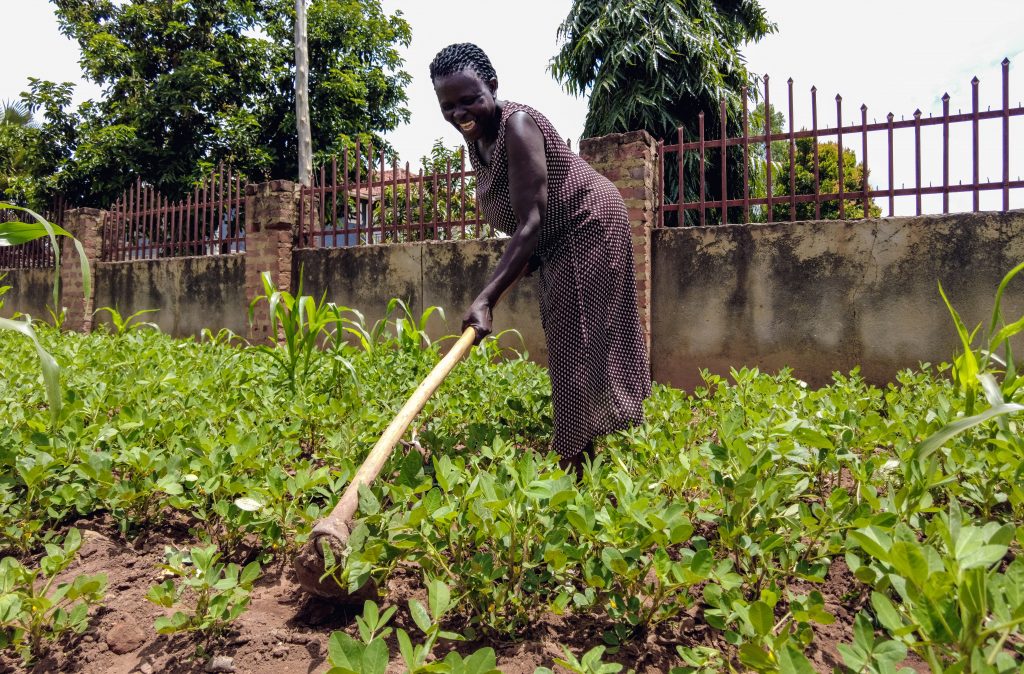
Photo credits: Curity Ogada
Charting a Way Forward
The truth is, Africa, Uganda included, will continue to face the devastating impacts of climate change even though Africa contributes a negligible amount of carbon emissions globally.
However, our rural communities also continue to face the wrath on an even larger scale, and this brings to focus the value of knowledge sharing, innovation in farming, and reducing dependence on rain-fed agriculture.
It would now be more beneficial to implement and regulate the great policies that already exist, have active agricultural officers who actually interact with grassroots farmers to allow their needs to be planned ahead in budget allocations, and resurrect cooperatives that actually work for the benefit of all farming communities.
It is also important to note that working together is key: all key stakeholders, including the media, must share and spread this vast knowledge across the board and boundaries to collectively spread climate-smart agriculture for a better, self-sustained Uganda.
Assisted by: Simon Wokorach, Freelancer at Uganda Radio Network, Gulu City, Uganda.
This story was funded by ACME (Africa Center for Media Excellence) in partnership with Climate Smart Jobs Uganda (CSJ)