

By Sharon Atieno
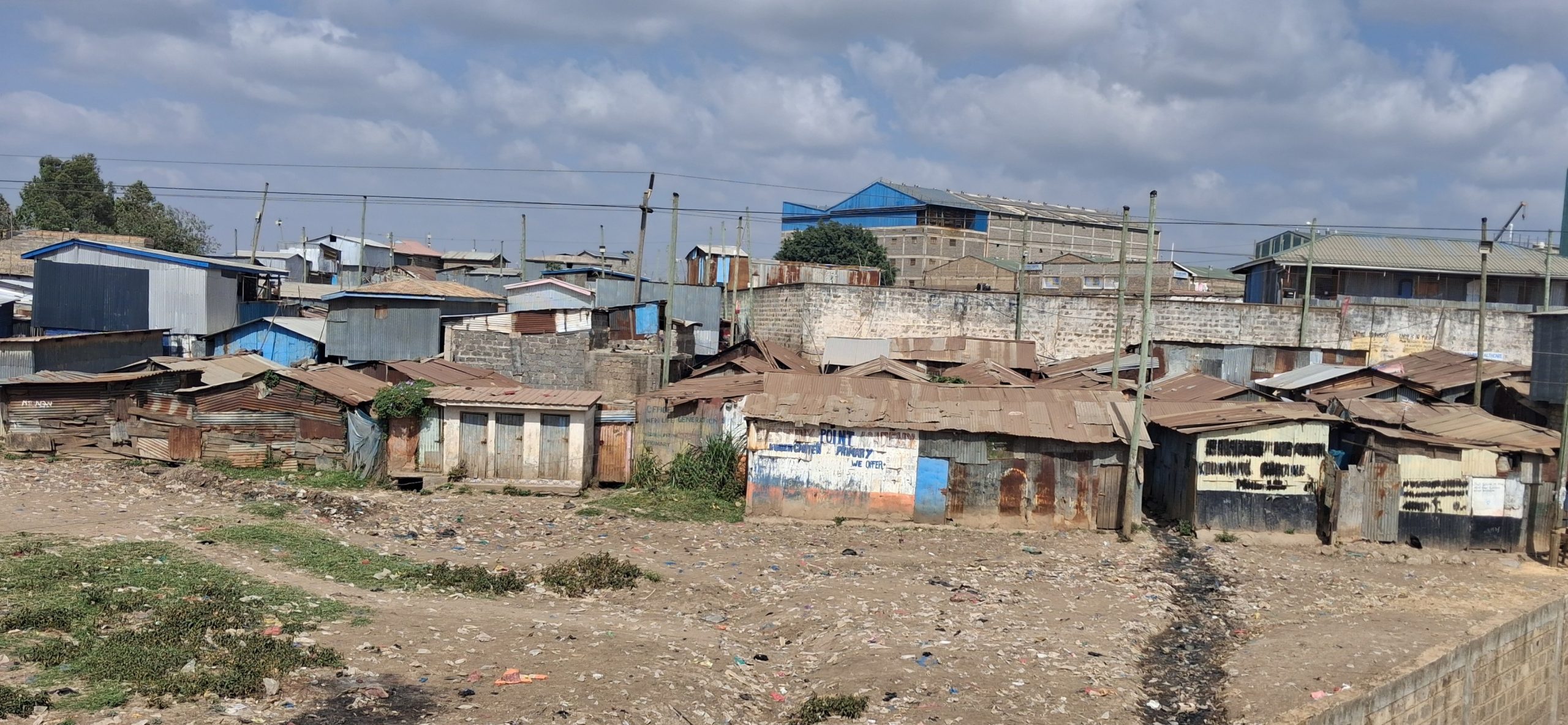
Victoria Wambui, a middle-aged woman in her 50s, has lived in Kibera, Kenya’s largest slum, for nearly 30 years running a small grocery business.
From her trade, she has been able to support her husband to take her four children to school. With the business being housed in a makeshift tin-roofed structure, climate change is taking a toll on it.
Excessive heat is a big problem for her products. “When I get my vegetables from the market, they are fresh and green, but by the time it is mid-day, they start wilting due to the heat. By the time evening reaches, some of them have lost their green colour and look yellowish. People want vegetables that look fresh, those that have become wilted and yellow cannot be sold,” Wambui says, adding that they are forced to throw them away or give them as feed to chicken farmers.
She laments that an investment of shs. 500 (US$ 4) in buying green vegetables from the market results only in shs. 150(US$ 1.2) at the end of the day while a crate of tomatoes bought at shs. 6,000 (US$ 46) are sold for shs. 3,500 (US$27).
“The heat makes the tomatoes and fruits to ripen quickly and eventually some become rotten. This is a huge loss but because this business is what sustains you, you keep on even if it means borrowing to supplement your stock for the next day,” Wambui adds.

She is not alone. Jashon Opudo owns a makeshift hotel in Mukuru slums selling local delicacies. The hotel has been his source of livelihood for the last three years.
Opudo notes that extreme heat is making his food to get spoilt quickly. For instance, a mixture of beans and maize (locally called githeri) would stay fresh for up to two days, but because of the heat, it only lasts a day. The food starts producing a foul smell hence, it cannot be served to customers.
For Opudo, refrigeration remains the only option. His income is too little to buy and run a fridge. “I have opted to change my menu. I no longer focus on the mixture of beans and maize. I have resorted to rice which is simple to cook and can be taken with a variety of options including with beans, tea or cabbage,” he says.
Additionally, Opudo is preserving his food with water. Putting the food in containers and placing it in water to keep it cool so that it does not get spoilt quickly. This is an added cost because he uses an extra of three jerricans a day just for food preservation. He was previously using seven jerricans for cooking purposes. The water is outsourced and he spends shs. 25 (less than a dollar) to purchase and transport a jerrican of water to the facility. On average he spends shs. 250 (two dollars) on water alone.
The preservation method does not work for all foods and sometimes he is forced to throw away raw vegetables which have become stale due to heat.
Climate change is resulting in intense and frequent heat waves-prolonged periods of heat, making it a global challenge. In Africa, particularly, the situation is becoming dire.
A research conducted by University of Illinois Chicago (UIC), found that there is a stark difference between the intensity, frequency and duration of heat waves in Africa during two periods: 1950-1979 and 1985-2014.
The 1950-1979 period was characterized by weak, infrequent heat waves, with about one occurring every three to eight years. About 80% of heat wave activity during this time could be attributed to natural causes, and the researchers highlighted the cooling effects of sulfate aerosol: airborne sulfur particles caused naturally by volcanic eruptions or anthropogenically through fossil fuel burning make clouds reflect more light back into space.
In contrast, the 1985-2014 period saw one or more heat waves every two years, lasting up to three times as long as in the previous period. These changes were mainly due to human activities like increased greenhouse gas and black carbon emissions. In this period, the researchers attributed only 30% of heat wave activity to natural causes.
The State of the Climate in Africa report, found 2024 to be the warmest or second-warmest year on record. The average surface temperature across Africa in 2024 was approximately 0.86 °C above the 1991–2020 long-term average. North Africa recorded the highest temperature (1.28°C above the 1991-2020 average).
“Raising awareness of heat waves is critical to saving human life,” said Akintomide Afolayan Akinsanola, head of the Climate Research Lab and assistant professor of earth and environmental sciences in the UIC College of Liberal Arts and Sciences in a statement. “In a developing continent like Africa, where the capacity for adaptive infrastructure is relatively low, heat waves can have greater consequences.”
The International Labour Organization (ILO) estimates that, in 2030, 2.2 per cent of total working hours worldwide will be lost to high temperatures – a productivity loss equivalent to 80 million full-time jobs.
Further, the economic losses due to heat stress at work were estimated at US$280 billion in 1995; this figure is projected to increase to US$2,400 billion in 2030, with the impact of heat stress being most pronounced in lower-middle- and low-income countries, where most African countries are categorised.


