By Sharon Atieno
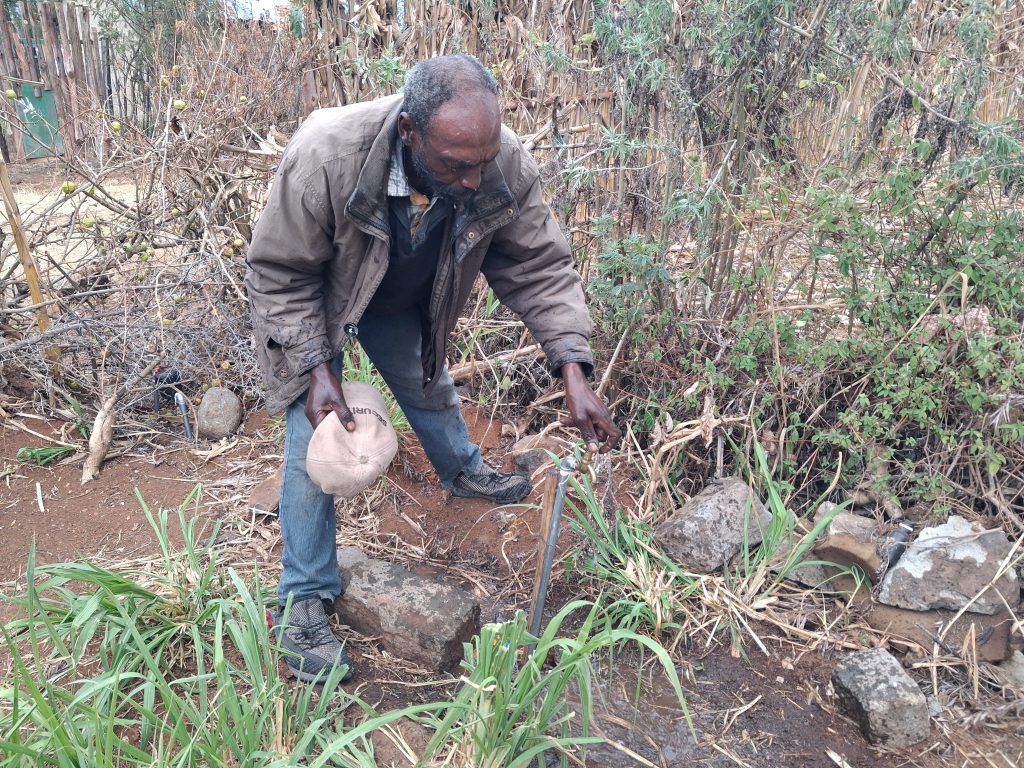
For Isack Njoroge, a widower and father of three disabled children, having tap water in his compound was a distant dream that seemed completely impossible.
He relocated to Kaimbaga ward, Ol Kalou constituency in Nyandarua county, Kenya’s central region, in 2010 through a government settlement programme. He was among the people who were displaced due to ethnic clashes in Molo, a region in the Rift Valley.
With no formal education, he does casual labour in the area, earning an average of shs. 250 (two dollars) daily. This is only enough to cater to the basic needs of his family, where he is the sole breadwinner.
In Kaimbaga, water is scarce, and most people depend on the dam, whose water has become contaminated. Njoroge lives one kilometer from the dam, and because he can’t afford to pay someone to bring him water, he used to set aside two working days to fetch enough water for his household.
“After fetching the water, I would leave it in the sun, so that the heat kills the germs. Despite that, my children would still get sick from drinking the water,” he says.
“Though they are disabled, when they would drink the water, you could see them scratching their stomach, or from how they are behaving, you can just tell that something is wrong.”
Today, things have changed.
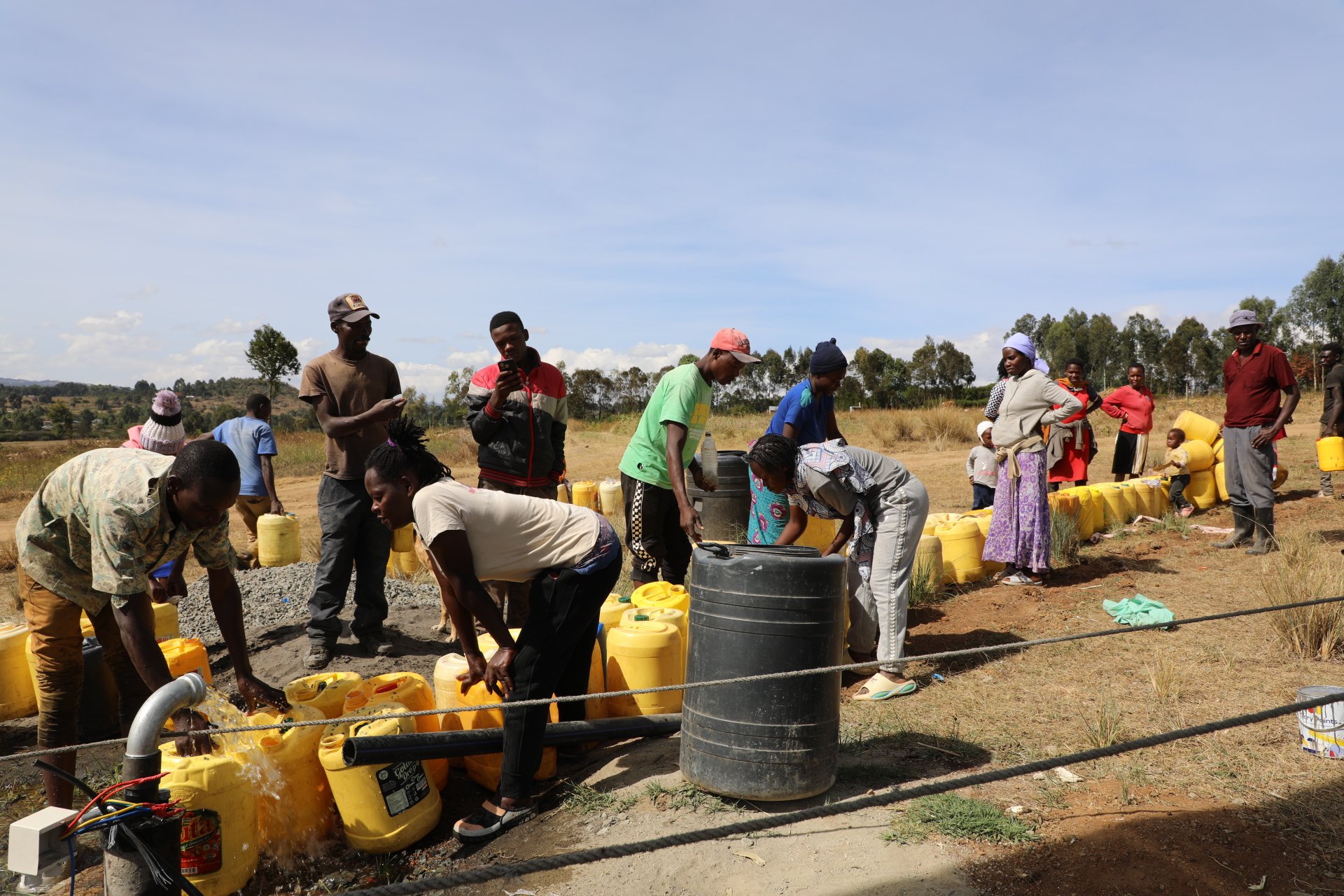
Njoroge is among the 20 vulnerable households that have received tap water as a result of the Mwiyumia borehole water project under the financing locally-led climate action (FLLoCA) program.
The program is a five-year initiative by the Government of Kenya, launched to address climate change at the grassroots level by empowering county governments and local communities.
Supported by the World Bank, Denmark (DANIDA), Sweden (SIDA), and other partners, this initiative aims to decentralize climate finance, ensuring that funding directly supports community-prioritized resilience projects.
“We settled on this project because this is a dry area and water is our biggest challenge. Our only source of water is the dam, but the water is very dirty. Many residents would fall ill because of drinking that water,” says George Mbogo, Chairperson, project management committee (PMC) in Kaimbaga ward.
He adds that some of the residents are also not able to walk long distances to fetch water and are forced to buy. With a 20-litre container of water costing shs. 20 (less than a dollar)- not many can afford.
The Mwiyumia borehole project is 214 m deep with a production capacity of 29 cubic metres per hour and is equipped with a high-elevation pressed steel tank with a capacity of 24 cubic metres, ensuring a steady water supply in the area.
Mbogo says that the first installation focused on extremely vulnerable members of the communities, including the elderly and people with disabilities (PWDs). They are targeting 500 households with piped water, but already 200 have been enlisted and are waiting for connection. Generally, over 3,000 households in the ward are set to benefit from the project.
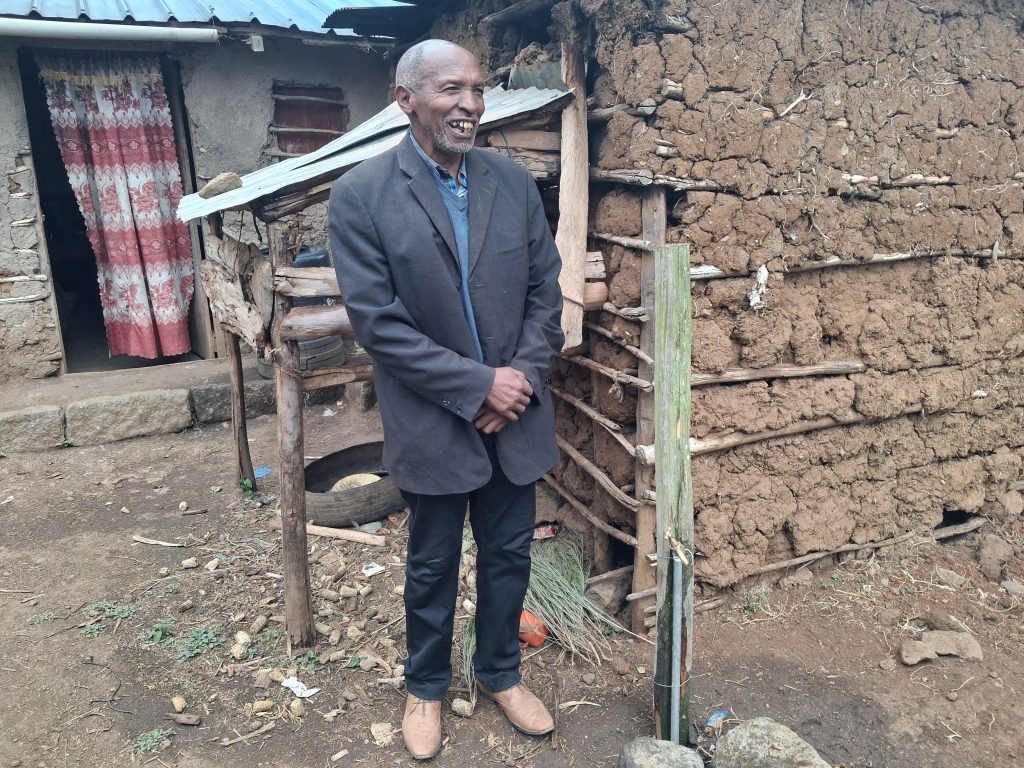
For John Kihara Mwangi, 67, a widower who lives alone, fetching water was not an option for him. Because of his age, he was forced to spend shs. 150 (US$ 1.2) daily, getting people to fetch water for him.
“I am very happy that I have water nearby. I can now comfortably do my chores. I also get to save my money and spend it on other things,” says Mwangi.
Globally, the United Nations estimates that more than two billion people don’t have access to safe drinking water, and roughly half of the world’s population is experiencing severe water scarcity for at least part of the year. These numbers are expected to increase, exacerbated by climate change and population growth.
Further, limiting global warming to 1.5°C compared to 2°C would approximately halve the proportion of the world population expected to suffer water scarcity, although there is considerable variability between regions.
Worse still, higher water temperatures and more frequent floods and droughts are projected to exacerbate many forms of water pollution – from sediments to pathogens and pesticides.
Recently, the African Union (AU) announced that the theme for 2026 is “Assuring Sustainable Water Availability and Safe Sanitation Systems to Achieve the Goals of Agenda 2063.” The call underscores the need for sustainable water management, particularly to increase climate change resilience.
In Kenya, water continues to be a priority for counties to strengthen their climate change resilience. Under the FLLoCA program, most counties are directing a larger share of the funding to the water sector.
Busia County, for instance, allocated 43.7% of its 2024/2025 FLLoCA finance to the water sector. The funds were used to prioritize hybridization, augmentation, and solarization of water infrastructure to ensure sustainability.
While these projects are strengthening resilience, ensuring their long-term sustainability beyond the lifespan of the FLLoCA program remains the critical challenge.