By Milliam Murigi
For years, in Yatta Sub-county’s Kalyambeu village in southeastern Kenya, rainfall was extremely erratic.
When it rained, River Mwita Syano, the river serving this community would roar to life. Spilling over its banks and rushing past farms carrying away what could have sustained the community for months.
Then, just as quickly, it would disappear a few weeks after the rain stopped, leaving behind dry fields, long treks for water and a familiar anxiety.
“This is a seasonal river, the only source our community has relied on. When it dries up, we are forced to walk more than five kilometres in search of water from boreholes sometimes even farther, because the queues there are often long,” says Mumo Kimetu, an area resident.
Because of this seasonality, farmers never relied on the river as a stable source of water for farming. Instead, they depended entirely on rainfall to grow their crops, carefully timing their planting seasons around the onset of the rains and adjusting their farming activities to match the unpredictable weather patterns.
When the rains delayed or was insufficient, their production was severely affected, leading to reduced harvests and increased vulnerability for their households. However, today, that story is beginning to change.
Some community members have started to irrigate their farms, courtesy of the Kwa Masele Irrigation Weir Project. This is a community-led initiative designed to capture and store water from the seasonal river, ensuring a more reliable supply for irrigation and livestock use, especially during dry periods.
“This project has been of great help to us. Because of it, we are now able to irrigate our farms, grow crops even during low rainfall and improve our food production and livelihoods,” Kimetu says.
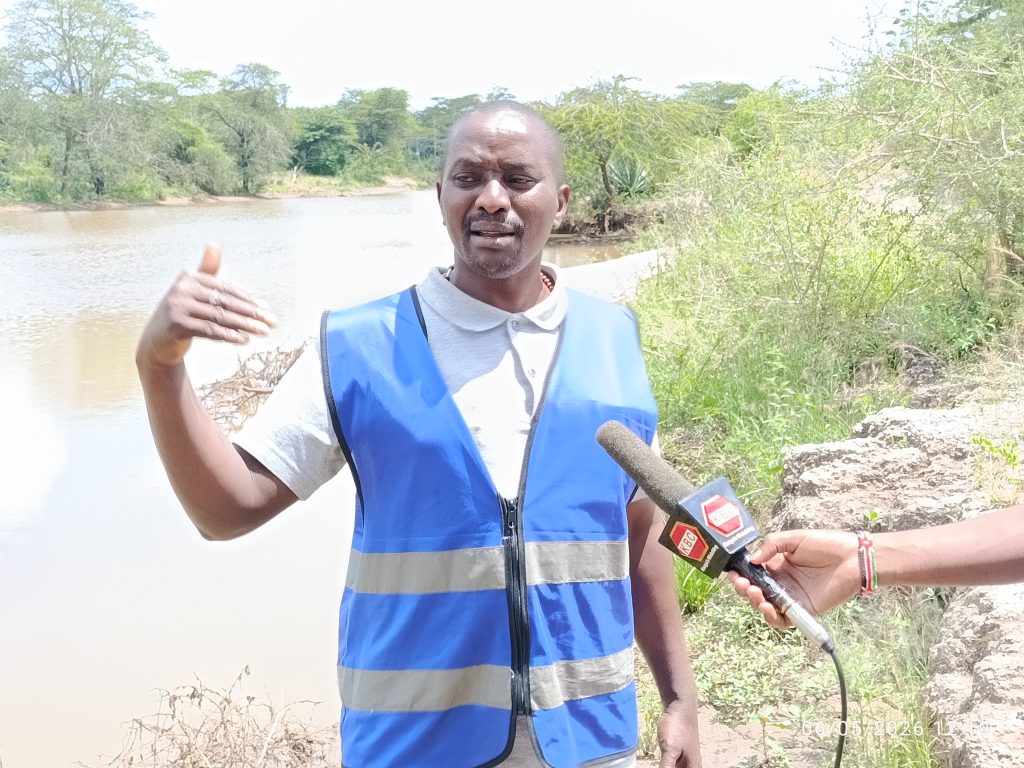
The project features a weir, a small barrier built across river Mwita Syano to control the flow of water. The structure captures and stores water that would otherwise go to waste creating a reservoir. Water from this reservoir is what is reshaping livelihoods in this semi-arid landscape.
Unlike sand dams which are common in this county, and stores water beneath layers of trapped sand, a weir, holds back flowing water to form an open reservoir on the surface. This makes the water directly visible and easier to pump for irrigation and other uses.
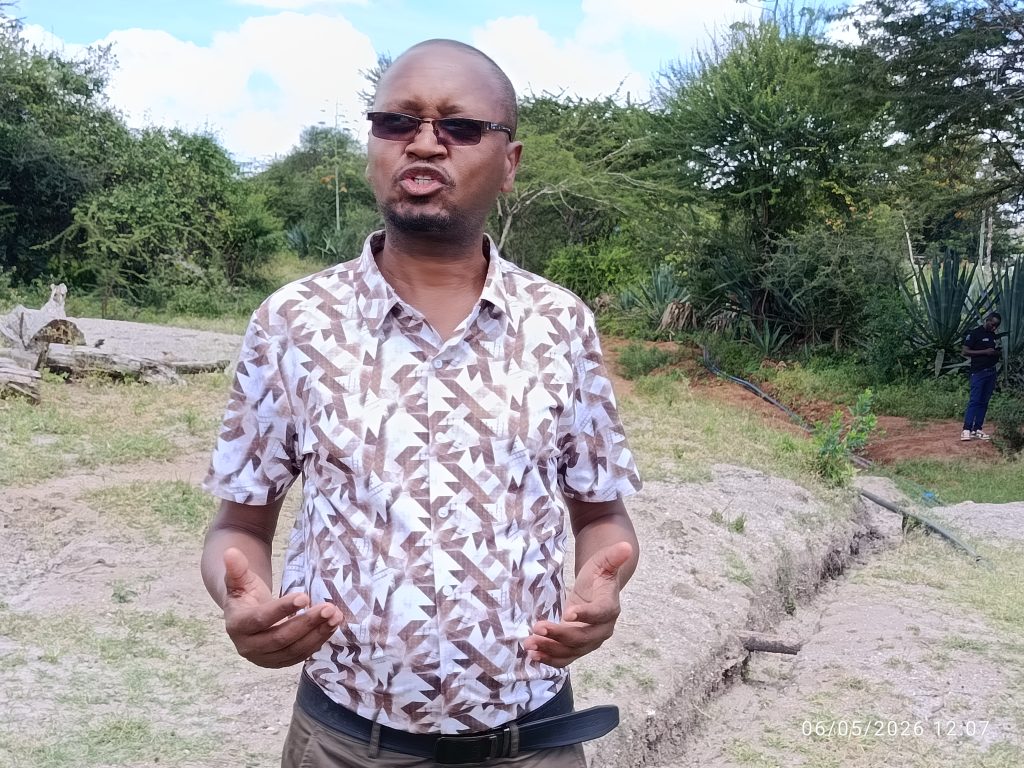
“This is a key water infrastructure project aimed at enhancing agricultural production and improving livelihoods. It was developed with the agreement of the community, and its main purpose is to support irrigation activities,” says Joshua Musyoka, Monitoring and Evaluation Officer Climate Change Unit, Machakos County.
The project is funded under the Financing Locally-Led Climate Action (FLLoCA) Programme in partnership with county governments. FLLoCA is a national initiative that channels climate finance directly to local communities, enabling them to design and implement solutions tailored to their own risks.
By investing in locally driven infrastructure, FLLoCA aims to strengthen resilience at the grassroots level ensuring communities are better equipped not just to respond to climate shocks, but to anticipate and withstand them.
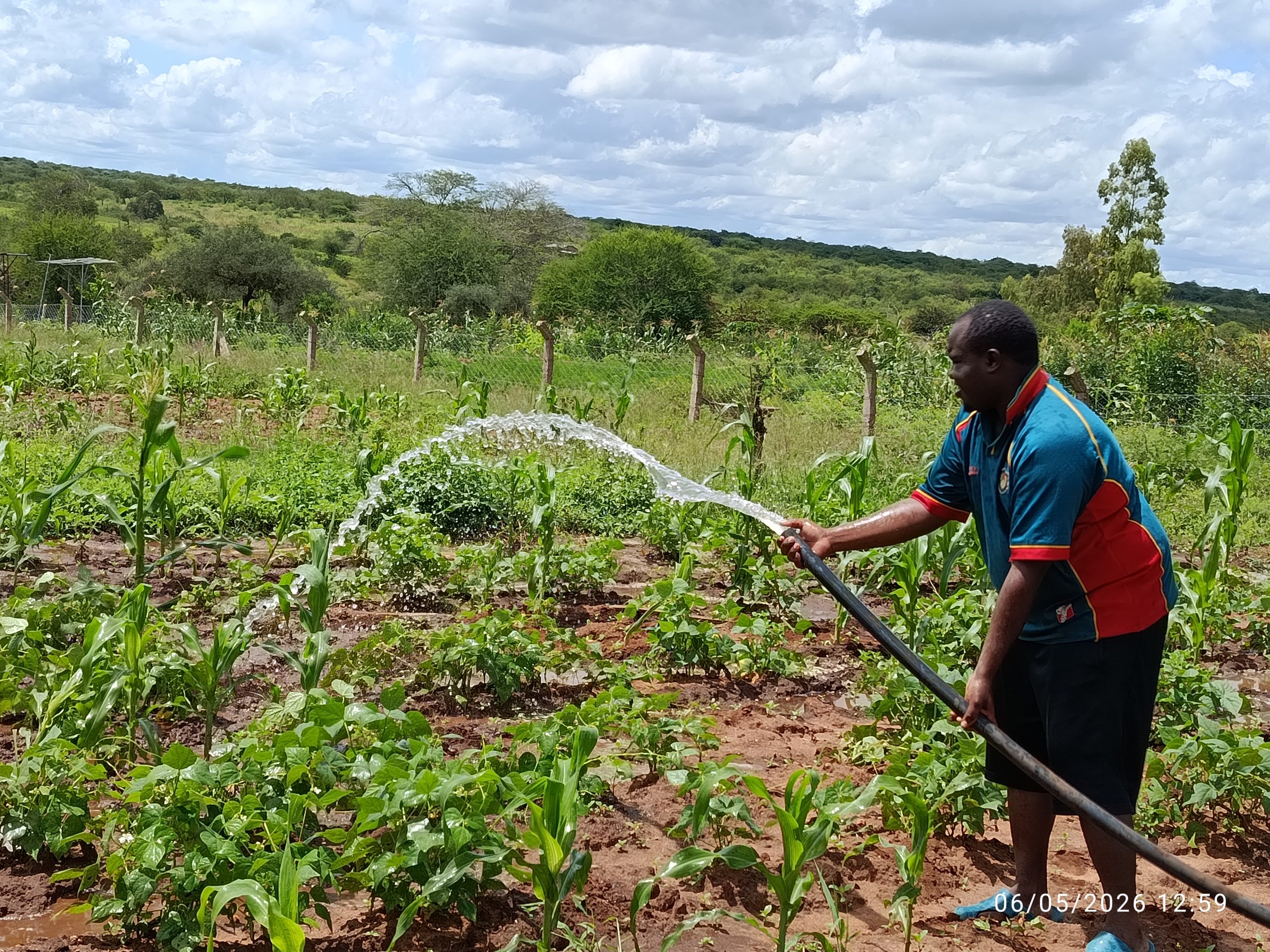
Even though the project is not fully complete, about ten farmers have invested and installed solar-powered water pumps and are using the water to irrigate their farms, helping their crops grow and improving food production in the area.
“For many years, I have depended entirely on rain to grow my crops. When the rains failed, it meant hunger and low harvests for my family. We had no other source of water for farming. However, since the weir was built, things have started to change,” says Steve Kyombe, a resident.
He is one of the farmers who are using water from this reservoir for irrigation. His farm today tells a different story. Rows of maize and beans at different growth stages stretch across part of his land, while fruit trees and leafy vegetables thrive- crops that once struggled to survive beyond the rainy season.
This change is largely attributed to the availability of reliable water for irrigation. With the help of solar-powered pumps drawing water from the reservoir, the farmer is now able to irrigate his crops throughout the year. What was once a seasonal struggle has turned into more consistent farming, giving him better harvests and renewed hope for food security and income.
“I invested in my own solar pumping systems because the project is yet to install a pump and start distributing water to the residents. I am now able to grow food throughout the year without worry. I don’t have to wait for the rains,” Kyombe says.
For Kimetu, it is not about the crops. Until recently, he would walk up to five kilometres in search of water for his livestock. A daily routine shaped by scarcity and exhaustion. Now, he pumps water directly from the reservoir to his home.
The change has not only eased the physical burden but also freed up valuable time for other activities. Kimetu says he can now focus more on tending to his livestock and expanding his farm, instead of spending hours searching for water. With a reliable source now within reach, both his animals and crops are healthier, marking a significant shift in daily life and productivity for his household.
“The long journeys are gone. I no longer have to walk in search of water for my livestock. The weir has reduced the strain on me and improved the well-being of my animals,” he says
The reservoir, with a capacity of about 800,000 cubic metres, is expected to benefit over 2,000 people across five villages once fully complete. It will also support more than 1,500 cattle and 2,000 goats offering a lifeline in an area where livestock is central to livelihoods.
“We have done the first phase only and the community has started to benefit. This phase involved construction of the weir to form a reservoir. The second phase of the project will involve installing solar-powered pumps, storage tanks and distribution pipelines to expand access,” says Musyoka.
For Kimetu, the lesson extends beyond his own farm. According to him, since the county is dotted with so many seasonal rivers that flood briefly, then vanish, leaving little behind, this should be replicated in many places so that other farmers can also benefit.
In conclusion, Musyoka reveals that, as climate grows more unpredictable, such small-scale, community-driven solutions are gaining importance, noting that this project is just one of several similar initiatives being implemented to help communities adapt to changing weather patterns and improve water access.
“As a county we are prioritizing such projects because they do not stop the rains from failing but they ensure that when water does come, it is not lost. Often, water from heavy rains is not preserved. That is why we are introducing such projects across the county,” he says.