By Sharon Atieno Onyango
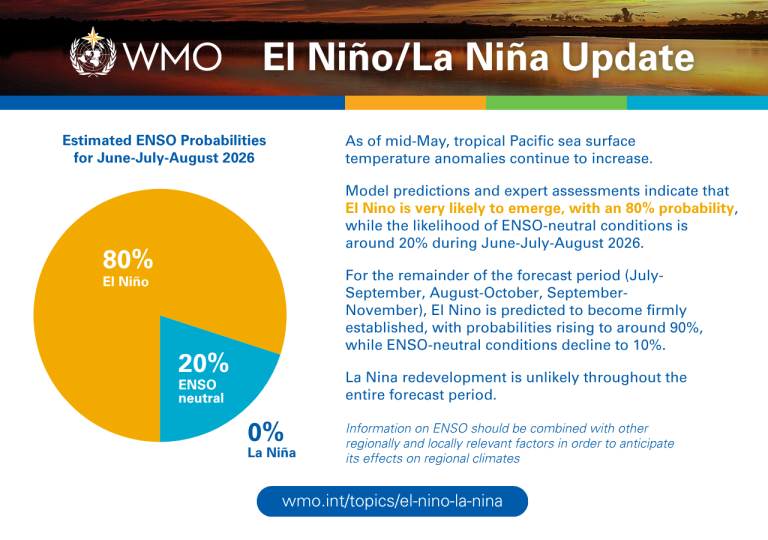
El Niño conditions are developing and are set to influence global temperature and rainfall patterns, increasing the risk of extreme weather over the coming months, according to the World Meteorological Organization (WMO).
Forecasts by the organization indicate an 80% likelihood of an El Niño event during June–August 2026 with probability of extending until November.
“The science is clear: El Niño is arriving on our doorstep in the coming months with 90% certainty. The world must treat it as the urgent climate warning it is. El Niño conditions will pour fuel on the fire of a warming world. Impacts will hit even harder, travel even farther, and cross borders with devastating speed,” said UN Secretary-General António Guterres, in his video statement.
“The only effective response is climate action equal to the crisis – ending the addiction to fossil fuels, accelerating the shift to renewables, protecting the most vulnerable, and delivering early warning systems for all.”
El Niño is characterized by a warming of ocean surface temperatures in the central and eastern Equatorial Pacific. It typically occurs every two to seven years and lasts around nine to twelve months.
It generally begins developing between March and June and reaches its peak intensity between November and February, with impacts on global temperatures typically being most pronounced in the second year after development.
“We need to prepare for a potentially strong El Niño event – which will exacerbate drought and heavy rainfall and increase the risk of heatwaves both on land and in the ocean. The most recent El Niño, in 2023-24, was one of the five strongest on record and it played a role in the record global temperatures we saw in 2024,” said WMO Secretary-General Celeste Saulo.
“The WMO community will be carefully monitoring conditions in the coming months to inform decision-making by governments, humanitarian agencies and climate-sensitive sectors. Advance seasonal forecasts and early warnings are vital to save lives and cushion the impact on our economies and our communities.”
This announcement comes amidst Trump administration’s intended plan to dismantle the Ocean Observatories Initiative, a deep-ocean observation system that provides essential data to monitor coastal environments, marine ecosystems and powerful currents that shape the world’s climate.
The El Niño forecast requires careful monitoring of ocean conditions to understand implications for marine wildlife, fisheries and coastal communities.
“Walking away from a $368-million investment in a state-of-the-art system, a feat of engineering already paid for by the American people, is absolutely myopic. This system is a vital scientific asset that quietly protects American lives, communities and the economy through unfettered access to world-class scientific data. Its loss would create an irreparable blind spot for our country in predicting earthquakes, fishery health, storm forecasting, coastal flooding and more. It just doesn’t make sense,” said Chris Robbins, Ocean Conservancy’s associate director of scientific initiatives.