By Sharon Atieno Onyango
Every morning, before the sun rises high, Riziki Ali, 26, would strap her baby to the front and set out on a familiar journey armed with two empty jerrycans hanging on her side.
Tana River, the only water source in the area, lies about 2km from her home in Taleo village in the semi-arid plains of Tana River County, southeastern Kenya. Covering this distance with a baby was an arduous task often taking one and half to two hours for one round trip. In the morning, she used to make two trips and one trip in the evening.
“If I didn’t make the three trips, I wouldn’t have enough water to manage the needs of my household. My oldest child is not old enough to be sent to the river alone,” she says, adding that because the river has crocodiles, one has to be very cunning to fetch water.
In Kenya, women and girls, 15years and above, are responsible for fetching water in most households that do not have access to drinking water in the premises.
Globally, women are responsible for collecting water in over 70% of unserved rural households, costing them a total of 250 million hours daily, a UN Water report finds.
Ali has a small groundnut business that helps to supplement her household’s income. But many are the times it has been disrupted due to the need for water security in her home.
“It was very difficult to run my groundnut business because I would go fetch water in the morning but by the time I come back and start working on the house chores, it is already 1.00pm yet I am still not done. You need to roast the groundnuts during the morning so that by 2.00pm, it is packaged and ready for sale,” she says, noting that she would really struggle and some days end up not doing the business at all.
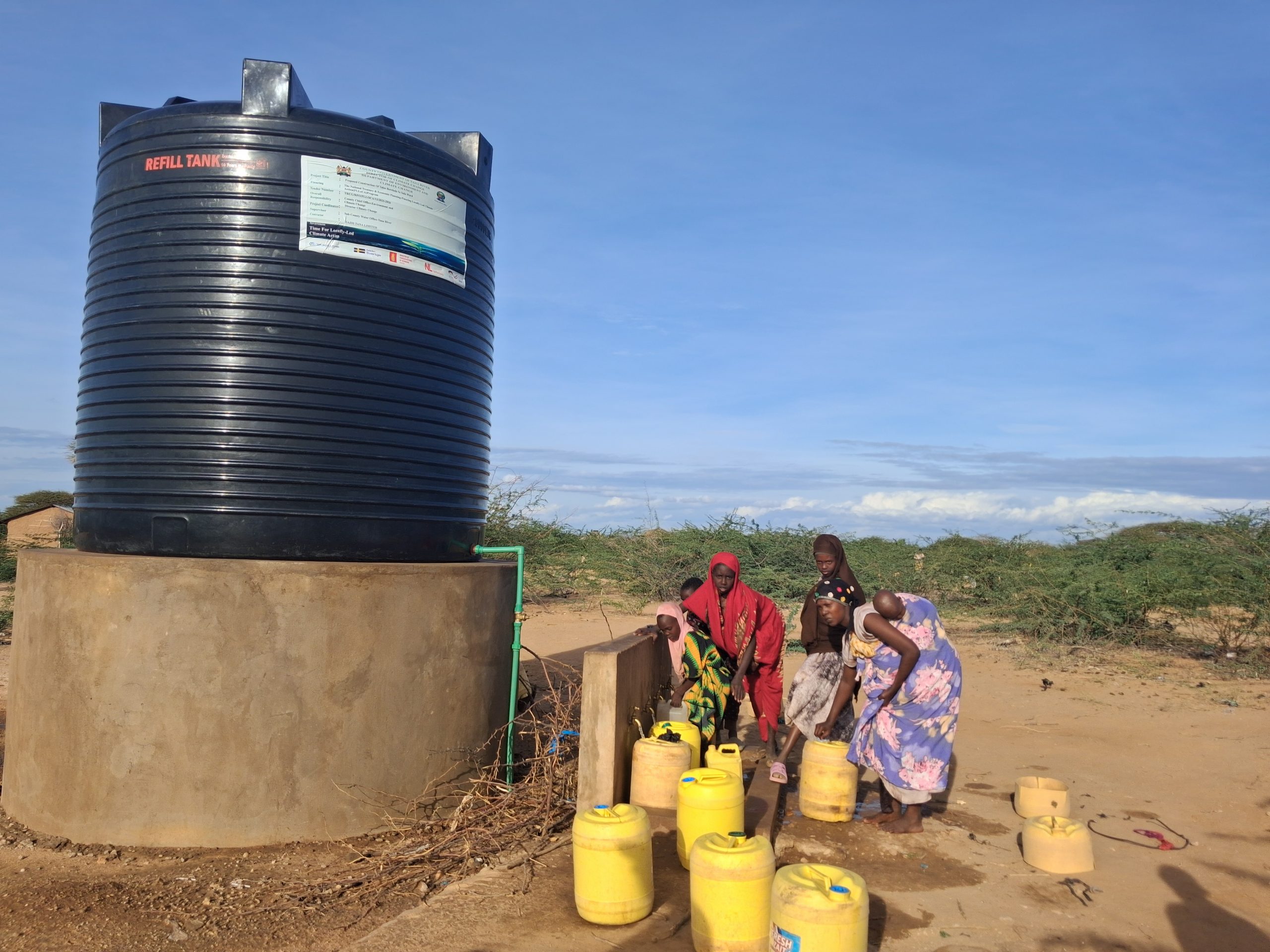
However, this has changed with the construction of the solar-powered Taleo borehole in Taleo village in Sala ward. The water serves some 400 households in the village and hundreds more from the neighbouring villages.
The initiative was developed under the Financing Locally-Led Climate Action (FLLoCA). This is a national, five-year program in Kenya spearheaded by the government and supported by the World Bank and other partners.
The program using a bottom-up approach empowers communities to identify, plan and execute climate resilience and adaptation projects that fit their needs.
Through ward climate change planning committees, members of the communities are sensitized about the fund and the need for them to identify a project which will help in increasing their resilience in the face of climate change. The sensitization comes through open forums like chief’s barazas.
Once the project is identified and agreed upon through voting by the communities, the ward committee drafts a proposal which goes to the county climate change committee and others for review and technical alignment then the county steering committee for final validation and approval. Once approved, funds are allocated and the project commences.
According to Abdullahi Dulo, a resident of Taleo village, the borehole project was a priority for them because the drinking water was brown and not conducive for drinking.
“We were constantly falling sick with cholera and diarrhea cases but because there is no other alternative, there is nothing much we could do,” Dulo says. “However, this water is now clean and we drink it directly from the taps, no need to even boil it.”
According to Kenya Demographic and Health Survey, 2022, nearly seven in every ten Kenyans (68%) have access to safe drinking water. However, approximately 31.6 per cent of the population uses unimproved drinking water sources.
Notably, about one in every five persons (23%) in rural areas uses surface water sources for drinking purposes.
These comprise of 7.3 per cent of the population using unprotected dug wells, 4.4 per cent using unprotected springs, 1.5 per cent using tanker trucks or carts with drum, and 18.4 per cent using surface water like rivers and lakes among others.
Dulo also notes that their livestock are also well hydrated though there is need for troughs to be built so that livestock can have their own side for drinking water.
For Ali, the borehole is a saving grace. Standing some 200-300 metres away from home, she is able to send her four-year old daughter to go and fetch water knowing she is safe and within her watch.
“I can fetch water any time I want. I don’t have to go very early and I can even fetch it in the evening unlike before when I had to consider the time due to the heat and the distance,” she says. “My business is also thriving as I am able to better plan myself due to the proximity of the water source.”
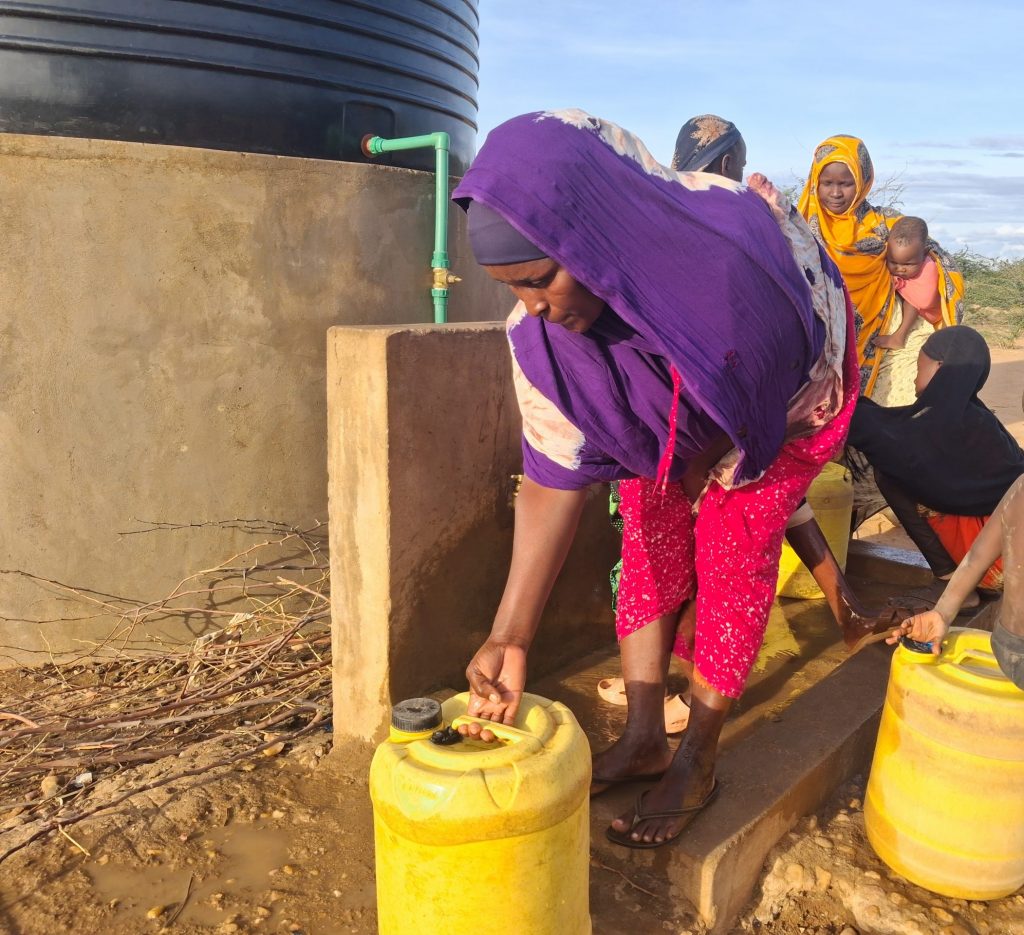
Ambia Hamisi, water project committee member, says the water has been a source of relief especially for the women who were trekking long distances in search of water. Personally, she would go to the river thrice a day dragging with her two 20l jerrycans each trip.
“For a mother with school going children, you need a lot of water to wash their clothes. Children would go to school with dirty uniforms but that has changed,” Hamisi observes.
She is concerned that the 10,000l storage tank needs a shade to avoid the sunlight hitting it directly. Also, that some of the water pipes need repair as they have been witnessing some leakages.
Solar-powered boreholes are becoming a widespread climate-resilient water solution to address chronic water scarcity, particularly in drought-prone rural communities.
This technology involves a borehole equipped with a submersible pump powered by solar energy. Solar panels convert sunlight into electricity, which drives the pump to extract groundwater from the borehole. This water is then stored in elevated tanks, allowing for gravity-fed distribution to various community access points or taps.
The dependence on solar power completely removes the need for grid electricity or the continuous expense and environmental impact associated with fossil fuels. This characteristic makes the system environmentally sustainable and resilient to power outages and the volatile fluctuations in fuel costs. This feature is particularly handy in remote rural areas like Taleo village, where conventional power infrastructure is either entirely absent or highly unreliable, ensuring a consistent and dependable water supply year-round.