By Sharon Atieno Onyango
As overfishing and environmental pressures lead to a decline in fish populations, Kenya’s coastal communities are turning to alternative income sources such as seaweed farming.
In comparison to Tanzania, which grow 92% of Africa’s seaweed, the country’s 15-year-old seaweed industry is small, contributing just 0.4% of the continent’s total output.
Despite this, the sector has become a significant contributor to Kenya’s Blue Economy vision. Anchored in the National Blue Economy strategy (2025-2030), the vision focuses on sustainably harnessing marine and inland water resources to drive economic growth, create jobs and ensure food security.
In Kwale County, for instance, more than 20 groups are engaged in the practice across 14 villages. To boost these efforts, the Kenya Marine Fisheries and Socio-Economic Development (KEMFSED) project awarded Ksh23 million (US$ 178,000) in grants to eight of these groups.
The funds, coupled with more effective extension services provided by the Kwale County Government with the project’s support, has enable the groups to rapidly expand their farms, increasing production and incomes.
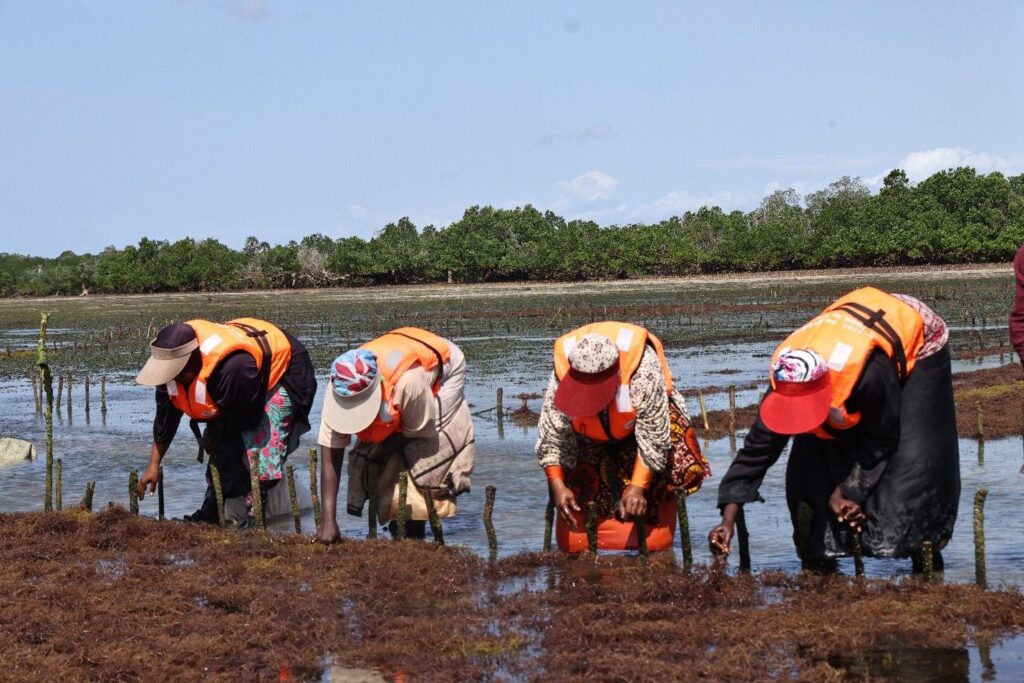
Tumbe Seaweed Farmers is one of these groups. Through the grant, the group, which started farming in 2022, purchased a boat to access deeper and more suitable waters as climate change and coastal warming made shallow areas less productive.
This has enabled them to expand. The farm now has 250 plots owned by individual members. Collectively, the 1,200 ropes yield about 3,600 kilograms of dried seaweed annually.
According to Rama Mwinyi, the group’s chairman, his 300 bags per cycle earn him more than Ksh 60,000 (US$ 464). “Our lives revolve around seaweed,” he says. “I get money from seaweed to pay school fees and meet other needs.”
The advantage of seaweed aquaculture is that it takes between 45 and 60 days to reach maturity depending on the variety and can yield six or more harvests per year. In Kwale county, the common varieties include Eucheuma spinosum and Eucheuma cottonii.
The KEMFSED funding also enabled the group to venture into value addition. They purchased equipment to process dried seaweed into powder, which fetches a better market price. Besides, they also produce natural beauty products such as body oil, shampoo, and soap. This diversification has created new income streams and encouraged more people to take up seaweed farming.
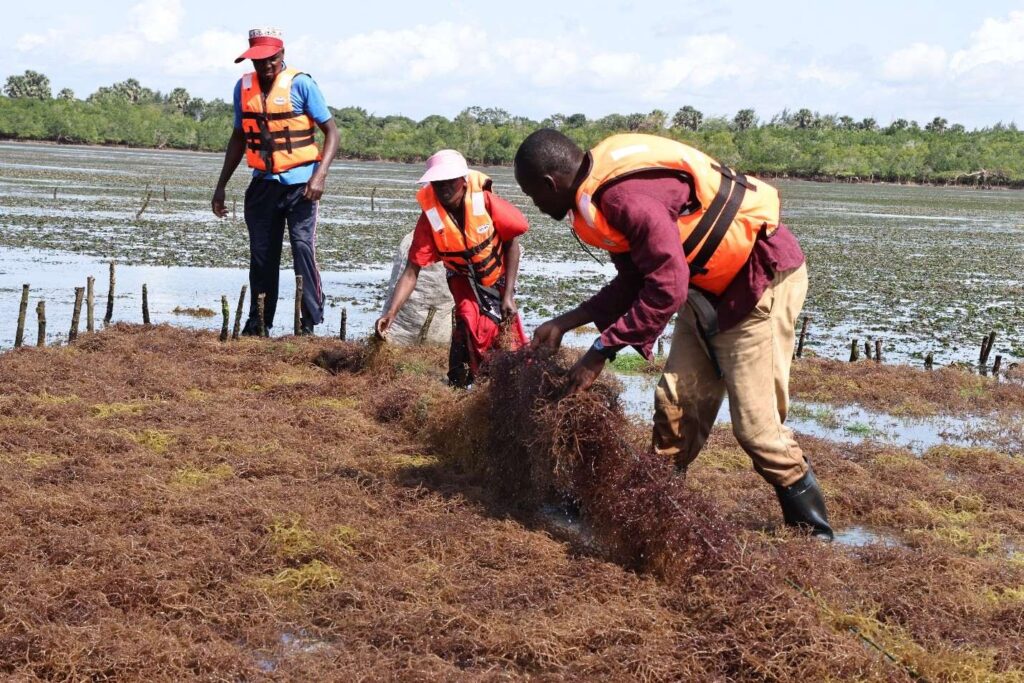
Photo credits: KEMFSED
Tumbe acquired its techniques and expertise from Bati Seaweed Farmers Group, another KEMFSED grantee, which started about six years ago, but now has an extensive farm with 12,000 ropes covering a total of 60,250m2.
The grant made it possible for them to purchase a boat which they use to reach their vast farm and ferry their produce ashore, relieving women of the task of wading through the water hauling heavy loads. The boat is also used to distribute seaweed seed to newer groups like Tumbe.
Bati’s farm produces around 5,000 kilograms of dried seaweed annually, which is sold or used as raw material for value-added products. Beyond providing steady income for hundreds of coastal households, seaweed farming is empowering women and youth—showing that the ocean’s natural resources can sustain vibrant, climate-resilient livelihoods.
KEMFSED is a Kshs. 10 billion (US$ 77 million) project implemented by the Government of Kenya, through the State Department for Blue Economy and Fisheries with support from the World Bank. It supports the country in its efforts to leverage emerging opportunities in the Blue Economy.