

By Milliam Murigi
Kenyan religious leaders are appealing to the government to urgently strengthen child protection measures, warning that existing laws and policies will remain meaningless unless they are fully funded, enforced and translated into action on the ground.
Speaking during the first National Religious Leaders’ Summit on Child Safeguarding, faith leaders drawn from different religious affiliations said Kenya has the legal framework to protect children but lacks the political will, adequate budgets and coordinated enforcement needed to stem rising cases of abuse, neglect and exploitation.
“It is not enough to have good policies sitting on shelves. These must become living documents that can actually help us achieve the objective of protecting our children,” said Rev. Dr. Elias Agola, Chairman of the National Council of Churches of Kenya (NCCK).
They urged the government to prioritize enforcement against all forms of child abuse and violations of children’s rights, noting that many cases go unpunished despite clear laws.
A major concern raised was the chronic underfunding of child protection. The leaders called for an increase in the national budget allocation to match the scale and urgency of violence facing Kenyan children, saying the lack of funding is frequently used to justify inaction.
“In most cases we are told, ‘we can do it, but we do not have the money,” Agola said. “Yet without proper budgetary support, the war against child abuse cannot be given the seriousness it deserves.”
The leaders also pressed for full implementation of the Children Act, 2022, at both national and county levels. While the law provides clear guidance on child protection structures and responsibilities, they noted that many counties have yet to establish the systems, staffing and funding required to operationalize it.
“The Children Act guides child protection at every level of government, but it will only work if we deliberately fund and implement it both nationally and in the counties,” Agola added.
Education emerged as another key pillar of protection. The leaders appealed for the expansion of bursaries and social protection programmes targeting vulnerable children, particularly those in marginalized regions, arid and semi-arid areas and informal settlements.
According to them, education remains the greatest equalizer. When children are denied schooling simply because their parents cannot afford it, they become even more exposed to abuse, neglect and exploitation.
They further called for the scaling up of safe houses and rescue centers across the country, noting that some counties still lack functional, child-friendly facilities. While acknowledging that children should ideally grow up in family settings, they said safe housing must be prioritized where families cannot guarantee safety.
“Rescuing a child is not enough,” Agola said. “The question we must ask is, are they truly safe after that rescue?”
On harmful practices, the faith leaders demanded stronger law enforcement against child marriage, female genital mutilation (FGM) and sexual violence, with zero tolerance for impunity. They warned against the misuse of culture or religion to justify harm to children.
Shortage of child protection officers was also highlighted. Urging the government to recruit, deploy and adequately resource officers in every sub-county, with priority given to high-risk regions.
“There are times when people hide behind culture or religious justifications to harm children. The law must take its course, regardless of tradition or belief,” he said.
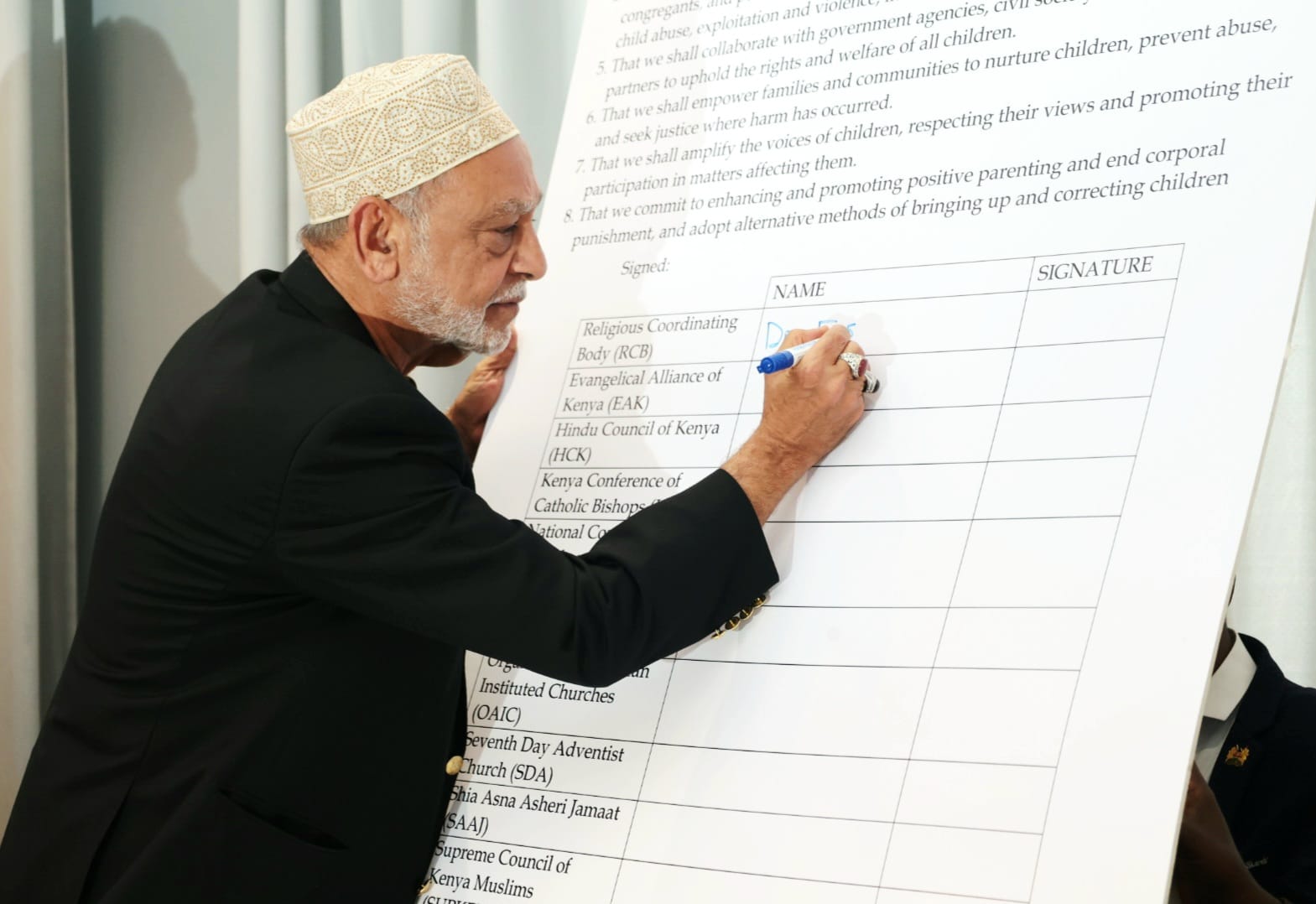
The leaders pledged to work more closely with government agencies, UNICEF and religious institutions to strengthen child protection at the community level. They reinforced this commitment by signing the National Religious Leaders’ Declaration on Child Safeguarding, a unified vow to safeguard children from abuse, violence and harmful practices.
The signing was accompanied by the launch of “Faith for Life: Protecting and Safeguarding Our Children,” a new faith-based safeguarding handbook designed to equip religious institutions with practical tools to strengthen child-friendly policies, promote safe practices and encourage positive parenting.
Together, the declaration and the handbook signal a decisive shift toward coordinated, values-driven leadership in child protection across Kenya.


