By Sharon Atieno
Single-use plastics, including straws, plastic bags, and food packaging, remain a major source of pollution. Their inability to decompose quickly and the majority being non-recyclable contribute significantly to this challenge.
The United Nations Environment Programme (UNEP) estimates that more than 400 million tonnes of plastic are produced annually worldwide, with half of it being designed to be used only once.
To tackle this menace, there is a push to focus on a circular economy, which involves a mix of regulatory, economic and innovative measures across the entire plastic lifecycle.
In the innovation front, South Africa is making great strides, particularly in material and design. Through the Centre for Scientific and Industrial Research (CSIR), the country is fostering the development of sustainable alternatives to plastics.
South Africa generates about 2.4 million tonnes of plastic waste annually, equivalent to 41 kg per person per year, which is higher than the global average of 29 kg per capita per year. Of this, only 14% is recycled, and around 40% of this waste is mismanaged, while three percent directly leaks into the environment.
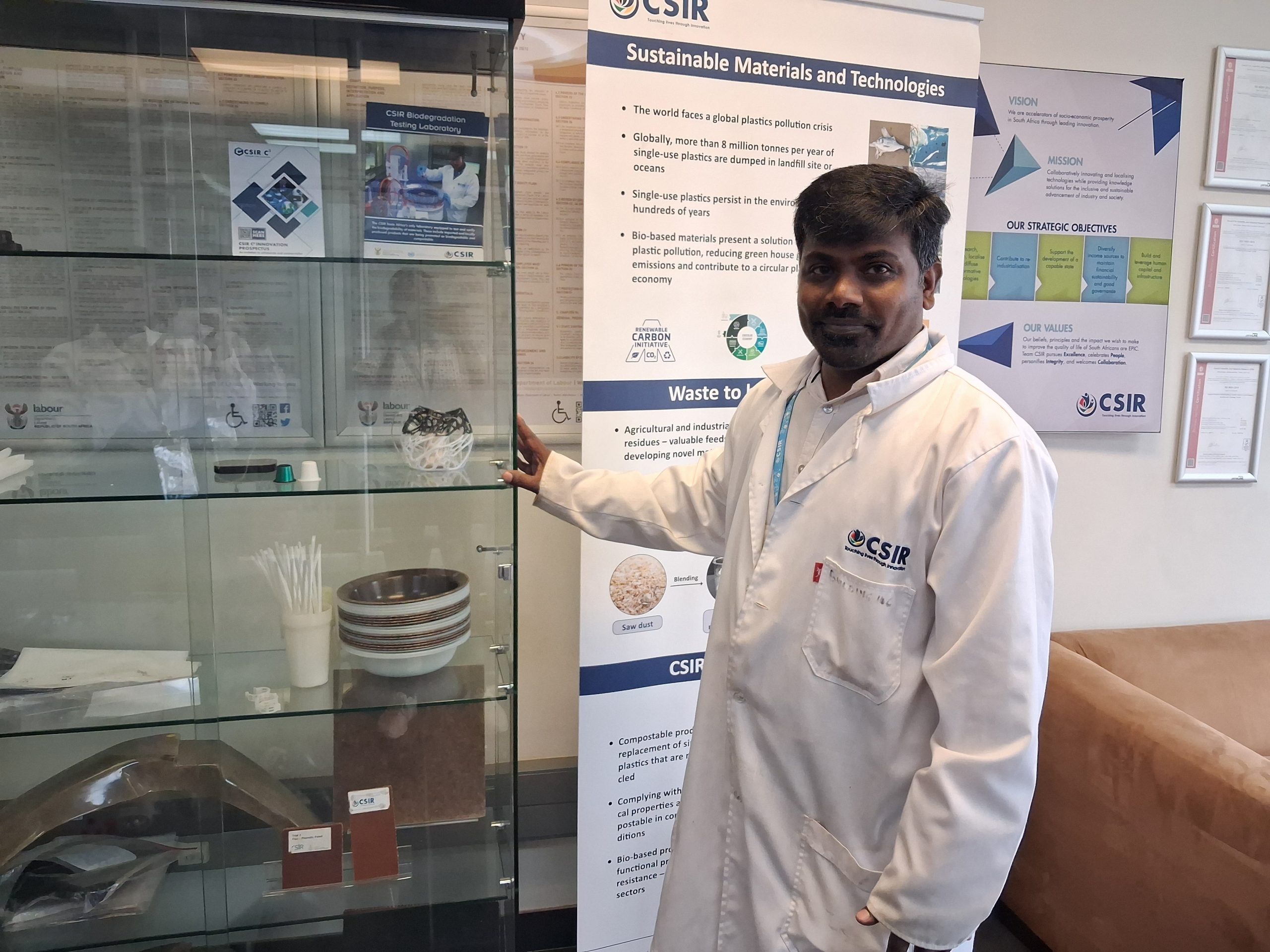
According to Dr. Sudhakar Muniyasamy, Principal Scientist, CSIR, the facility is developing eco-friendly material using local biomass available in the country. These include agricultural waste such as sugar cane bagasse, maize stock residues and other organic waste.
Highlighting that they are developing polymers from these organic waste, he notes that these products contain chemical components that are not harmful to the environment.
“Biodegradable products can replace conventional plastics, which take more than 100 years to degrade,” Dr. Muniyasamy stressed.
According to him, the agricultural sector is one of the biggest beneficiaries of this new technology. For instance, the researchers are developing a biodegradable mulching film to replace the plastic mulching film, which entails using a plastic film to cover plants to control weeds, retain soil moisture, and regulate soil temperature. This is mostly used in growing strawberries, pineapples and tomatoes.
Dr. Muniyasamy notes that these conventional plastics break into pieces after harvesting, leading to environmental contamination. However, with the biodegradable products, it will take a shorter time to decompose while enhancing the soil fertility because it is a natural product.
Some of the CSIR developed prototype products include compostable biomedical devices, biodegradable mulch films, bio-based cutlery, and bio-based components for transport sector.
Besides, the CSIR facility houses Africa’s only laboratory equipped to test and verify produced products that are being fronted as biodegradable. Funded by the Japanese Government, through the United Nations Industrial Development Organization (UNIDO).
According to Dr. Muniyasamy, the primary purpose of the testing facility is to verify whether a material is eco-friendly, how long it takes to degrade, and if any toxic substances leach during biodegradation.
The laboratory also aims to support industry, local manufacturers, and universities by verifying claims about material biodegradability and ensuring materials meet international standards.
Tests can be performed under different conditions: aerobic (compost, soil, fresh and marine water) and anaerobic.
Dr. Muniyasamy was speaking during a visit to the facility as part of the World Conference of Science Journalists (WCSJ) in Pretoria, South Africa. The conference takes place from 1st-5th December, 2025.
Themed “Science journalism and social justice: journalism that builds understanding and resilience”, the conference gives science journalists and their stakeholders an opportunity to interact, share ideas and information. It also stimulates debate and discussion and form solutions regarding how science journalists can contribute to building resilience amongst humanity given the challenges they face.