By Juliet Akoth
When the wind rises over Olooloitikosh village in Kajiado County, it sweeps dust across the dry ground as goats, sheep and cattle gather at a community borehole to drink. But the borehole is more than a watering point. It is also where members of Nadupoi, a women and youth group, meet to figure out how to survive as droughts intensify and life in this pastoralist community grows more uncertain.
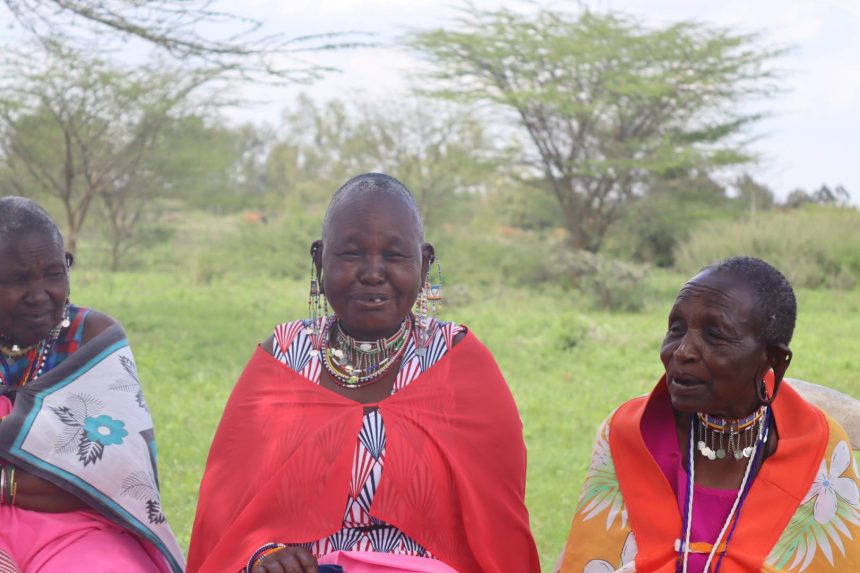
The group, made up of 28 members, is a collective comprising mostly elderly Maasai women. Since 2023, however, Nadupoi has also opened its doors to youth members who bring language skills, market connections and new ideas. They practice climate-smart farming, helping households secure food while also generating income.
Rebecca Koising’et, the group’s founder, traces Nadupoi’s beginnings to a simple intention: Solidarity. In 2011, she started bringing women together after seeing her neighbours, especially widows, struggle to afford school fees and medical care as drought weakened their traditional livelihoods.
“I formed the group because I was wanted to unify women to find solutions to their own problems,” Koising’et says.
“This coming together has helped us become one and advance while leaving no one behind,” she adds.
Immaculate Ntalalai, a widow and breadwinner, joined Nadupoi at its formation and has experienced its impact firsthand. When her husband died in early 2011, she was left to support three children alone. Previously, she and her husband had run a joint business selling livestock products. He sold meat while she sold milk. But his death left her vulnerable. As Maasai culture dictates, she had no rights to family property ownership. This allowed male relatives to sell off the animals for their own benefits.
Drought then decimated her remaining herd, leaving her destitute. “The situation was really bad after my husband’s death,” Ntalalai recalls.
“I struggled to provide for my family until I learned about the group,” she said.
Joining Nadupoi proved life changing. Through small loans offered by the group with three-month grace periods and the generosity of fellow members, she managed to send her children to school and ensure they had food and shelter. The group’s support later enabled her to purchase four sheep of her own.
Climate Smart Farming
The group’s biggest shift has been into farming. On an eight-acre parcel of community land entrusted to them by the Kajiado County Government, the women and youth now grow vegetables. They use climate smart practices, including crop diversification, bee keeping, organic manure and drip irrigation, to grow kales, curly kale, spinach, tomatoes and onions.
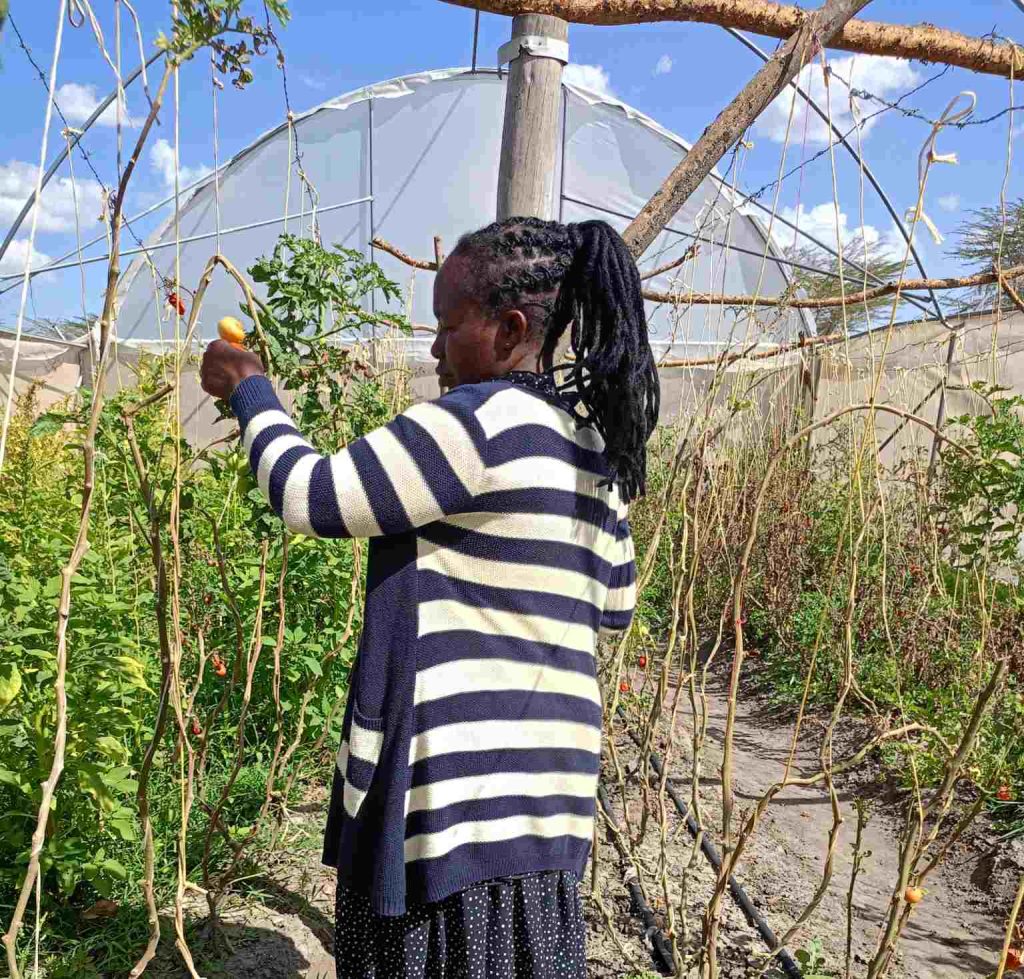
Nadupoi’s work mirrors the Kajiado County Climate Change Action Plan 2023 to 2027, which prioritizes climate-smart agriculture, water management and resilient livelihoods. It also speaks to Sustainable Development Goal 2 on food security, Goal 5 on gender equality and Goal 13 on climate action.
According to the group secretary Jane Parletuan, members began looking beyond livestock when they realized drought spells were becoming more frequent, clearing their herds of cattle and leaving them vulnerable to food insecurity.
“We realized we cannot depend on the cattle alone,” she notes.
“When drought comes, it can wipe out the herds. So, we started farming and even keeping chickens so that we have eggs, vegetables and other options for income and food,” Parletuan told MESHA.
But she is quick to add that this does not mean abandoning cattle. Instead, she argues, keeping smaller, manageable herds alongside farming is safer than chasing big numbers in a drying climate.
That adaptation is unfolding against a harsher climate backdrop across much of Kenya, specifically in arid and semi-arid lands.
Dr. Jackson Koimbori, an agro climatologist and Senior Circular Economy and Climate Change Coordinator at the Kenya Private Sector Alliance, says the most serious risks facing such communities are extreme heat, erratic rainfall and drought driven water shortages. These pressures are felt through livestock losses, crop stress and deepening local food insecurity.
“The key climate risks in most semi-arid regions in Kenya revolve around drought caused by rising temperatures and floods caused by extreme rainfall patterns,” stresses Dr. Koimbori.
He explains that the turn towards mixed livelihoods is a practical response. Crop production, he notes, can demand less water than keeping large herds, while losses may be less devastating and drought tolerant varieties are more accessible than climate resilient livestock breeds, communities still have to balance market demand with what can survive locally, but he sees diversification as necessary.
“I think the shift is part of them trying to adapt to the changing climate as it is right now,” he notes.
Nadupoi has already tested that logic. After a fish farming venture stalled because a pond liner tore, the group assessed the cost of restarting it against other urgent needs and put more energy into onion production, a shorter cycle activity that could bring quicker returns.
In October 2025, the group planted onions on 1.5 acres of community land and harvested 927 kilograms in two batches by January.
“When the market is very good, we sell at Ksh 70 (US$ 0.53) per kilo but when it’s very bad, we sell at Ksh 55 (US$ 0.42),” notes youth leader Emmanuel Masaga.
The group made an estimated profit of Ksh 64,000 (US$ 489.39) from this venture.
Farming with a Fragile Water Lifeline
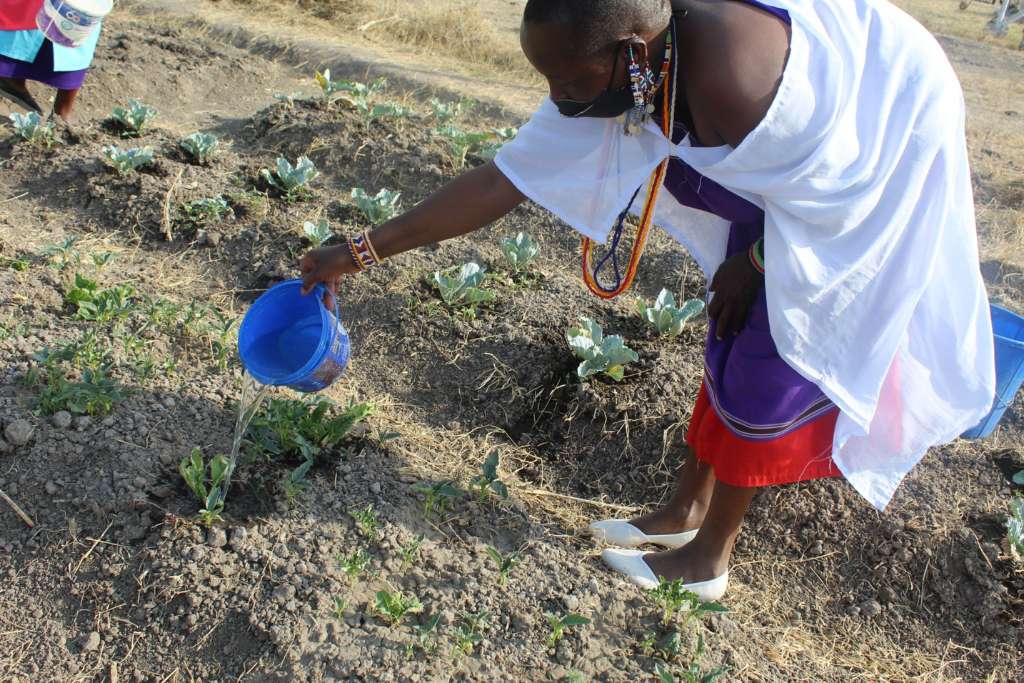
Yet even as Nadupoi produces harvests, the women and youth describe a ceiling they cannot break on their own: scaling. Their land, though eight acres in size, they only utilize 1.5 acres. Water and security are the main reasons. The community solar powered borehole supplies irrigation water, but its yield can drop, especially in the dry season when the water table falls.
When that happens, the group rations irrigation, watering one section today and another tomorrow.
“It’s not that water doesn’t come out,” Masaga says.
“Sometimes it comes out a little. So, we have to ration how the water is used. If we water a part of the farm today, the next day it won’t be watered; instead, another area will be watered. That is how we survive with what we have.”
Agro-climatologist Koimbori cautions that boreholes alone cannot sustain adaptation in drylands because they depend on groundwater recharge and can fail when rainwater is not retained. He argues that communities need water harvesting and storage systems, such as dams, to farm more reliably through dry seasons. But infrastructure alone is not enough.
“The lack of funding is a key issue,” he says, warning that without steady financing, planning and timely information, local projects remain stuck in survival mode.
Looking Ahead
Despite the challenges the Nadupoi Women and youth group is determined to succeed. Adaptation here is not a single act. It is a long, collective discipline, held together by women who refuse to be left behind, and by youth who refuse to watch their elders struggle alone.
This article was published by support from the Media for Environment, Science, Health and Agriculture (MESHA) and International Development Research Centre, eastern and southern Africa.
This story was first published by MESHA.