
By Milliam Murigi
Kenya has launched a landmark research financing and capacity strengthening masterplan, aimed at reshaping how science, research and innovation are funded, coordinated and translated into economic growth.
Launched during the closing ceremony of the inaugural Science, Technology, Research and Innovation (STRI) 4 Society Week, the masterplan will provide a roadmap for predictable research financing, stronger institutional capacity, improved research infrastructure, and deeper industry linkages to drive economic transformation.
“The masterplan is designed to reposition research and innovation as strategic pillars of Kenya’s development agenda, aligning directly with national economic transformation priorities,” said Hon. Dr. Musalia Mudavadi, Prime Cabinet Secretary during the launch.
It seeks to address long-standing structural gaps in Kenya’s research ecosystem, including fragmented funding systems, weak commercialization pathways and limited coordination between research institutions, policymakers and the private sector.
Supported by the United Kingdom’s Foreign, Commonwealth and Development Office (FCDO), the plan is expected to guide long-term investment in research institutions, strengthen scientific capacity and improve collaboration between universities, industry and government.
According to Dr. Mudavadi, the framework outlines four major focus areas: sustainable and diversified research financing, strengthened research infrastructure and digital systems, improved commercialization of research outputs, and enhanced policy and regulatory coordination across the innovation ecosystem.
A key ambition of the plan is to increase national investment in research and development toward globally competitive levels, while ensuring that scientific discoveries move beyond academic institutions into markets, industries and communities.
“The plan also reinforces Kenya’s broader goal of making research financing more predictable and less dependent on external donor cycles, a challenge that has historically slowed innovation scaling and long-term scientific planning,” he said.
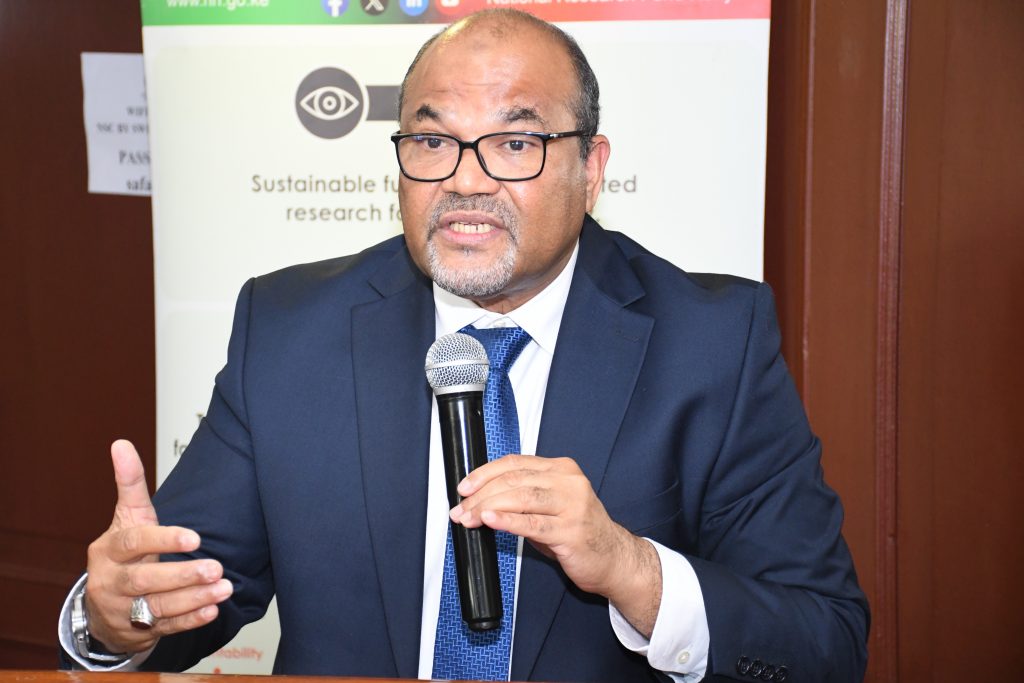
Speaking during the same event, Prof. Shaukat Abdulrazak, Principal Secretary, Science Research and Innovation said that the new financing framework will help accelerate the movement of research from laboratories into markets, communities and industries where innovations can generate economic and social impact.
He further noted that strengthening the financing framework is key to bridging the longstanding gap between research and commercialization, ensuring that scientific discoveries do not remain confined to academic spaces.
“By supporting innovators to scale their solutions, the initiative is expected to drive job creation, enhance industrial productivity, and deliver tangible benefits to communities across the country,” he added.
The masterplan announcement came alongside the unveiling of a new “Grand Challenge Kenya” platform, a locally driven scientific funding mechanism designed to finance Kenyan-led innovations tackling pressing social and economic problems.
Under the initiative, Kenya plans to provide six early-stage innovation grants of up to US$200,000 each, alongside four transition-to-scale grants worth up to US$350,000 for promising innovations over five years.
According to Prof Abdulrazak, the move is intended to reduce dependence on foreign-led research priorities while strengthening domestic scientific financing and commercialization of local innovations.
“Research without impact is a missed opportunity for society,” he said, calling for stronger university-industry partnerships that can translate research into jobs, patents, enterprises and policies.
The initiative also comes with a call for a broad coalition of stakeholders—including development partners, philanthropic organizations, academia, research institutions, industry leaders, county governments, and innovators—to actively participate in shaping a new phase of financing African innovation.
The appeal underscores the need to build sustainable, domestic funding mechanisms that strengthen Africa’s capacity to support its own scientific and technological advancement. Ultimately, the vision is to develop an innovation ecosystem that is firmly rooted locally yet globally competitive, capable of delivering transformative impact for future generations.
“If Kenya and Africa are to successfully leapfrog into a knowledge-based economy, science, research, and innovation must be placed at the center of national transformation and long-term development strategy,” said Prof Abdulrazak.