By Sharon Atieno Onyango
With an average annual rainfall amount of 275-360 mm, Garissa county remains one of the driest regions in Kenya experiencing frequent and prolonged droughts.
This has made farming in the region a costly venture as most communities especially along the riverine areas depend on small scale irrigation often using petrol or diesel pumps.
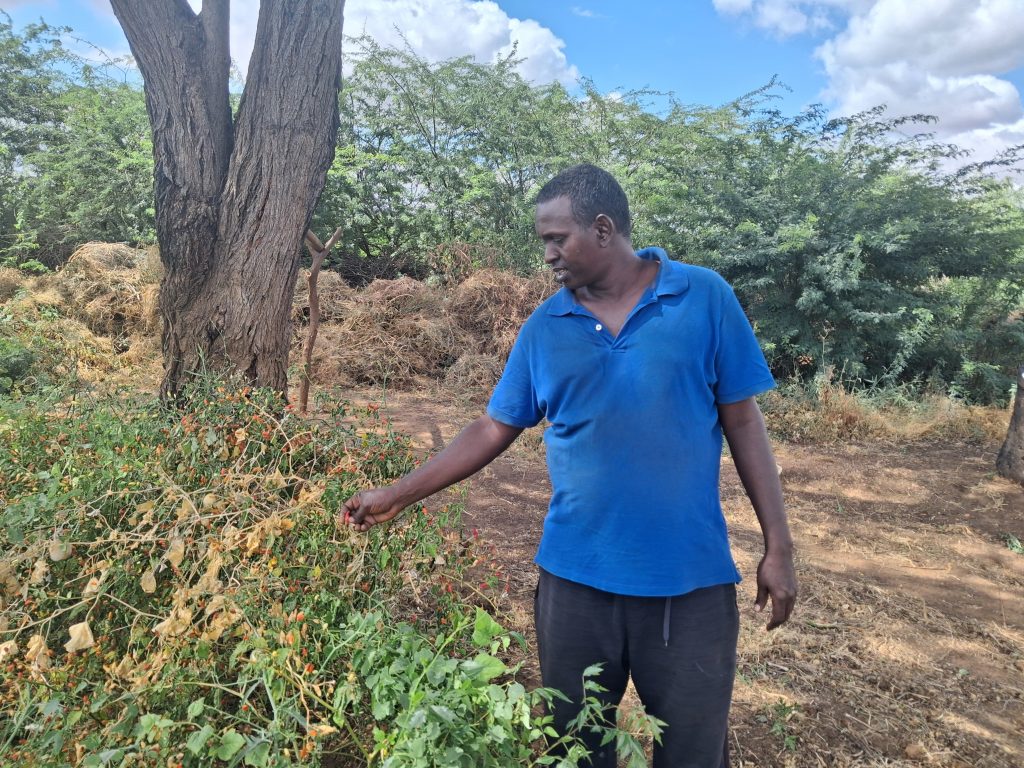
Muhammud Hassan, a farmer in Galbet ward, recalls drilling a borehole for him to access water because his two-acre farm is situated in a slightly sloppy area.
“The water from the river was not reaching here and during that time there were no solar pumps. Pumping the water from the borehole to my farm using a generator would cost me shs. 3000 (US$ 23) every three or four days for petrol,” he says, adding that despite the investment the returns were low due to inadequate market for the produce.
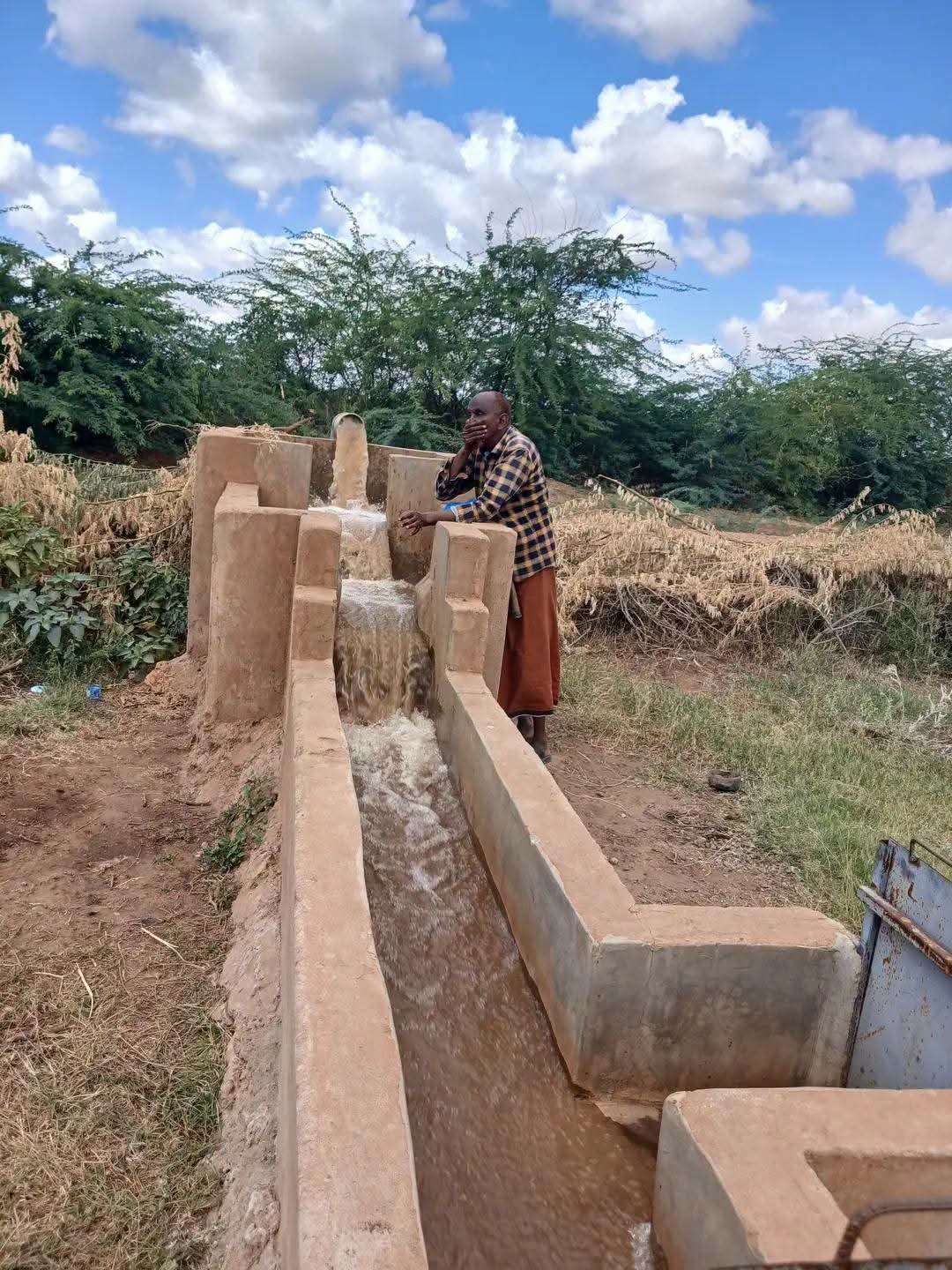
Hassan notes that since the establishment of the First farm irrigation project in the ward, things have changed for better. The water is readily available for their crops and it is free, using only sunshine. They no longer have to spend money to buy petrol or diesel.
The solar-powered irrigation project was developed by the county government under the Financing Locally- Led Climate Action (FLLoCA) program.
The five-year program by the government of Kenya is supported by World Bank and its partners and aims to deliver locally-led climate resilience actions and strengthening county and national governments’ capacity to manage climate risk.
The First farm irrigation project is as a result of a Participatory Climate Risk Assessment (PCRA) that was conducted in 2023. The PCRA report provides an in-depth, locally grounded analysis of current and future climate risks across the county’s 12 out of 30 wards.
Through a participatory process involving communities and multi-stakeholder engagement, the report outlines vulnerability profiles, differential impacts across demographic groups, and climate-conflict linkages. It culminates in a prioritized matrix of locally led adaptation investments (LLAIs) in water resource management, early warning systems, climate-smart agriculture, and climate-sensitive planning.
Through FLLoCA, 80 of the 200 acre-community land has been furnished with 1km of pipeline which benefits the 60 members directly with water for cultivation. A flood-proofed pump house which hosts the pump set has also been constructed. The farm has been supplied and installed with 36 solar panels of 535 watts each. Also, farmers were given 400 assorted fruit seedlings to support them.
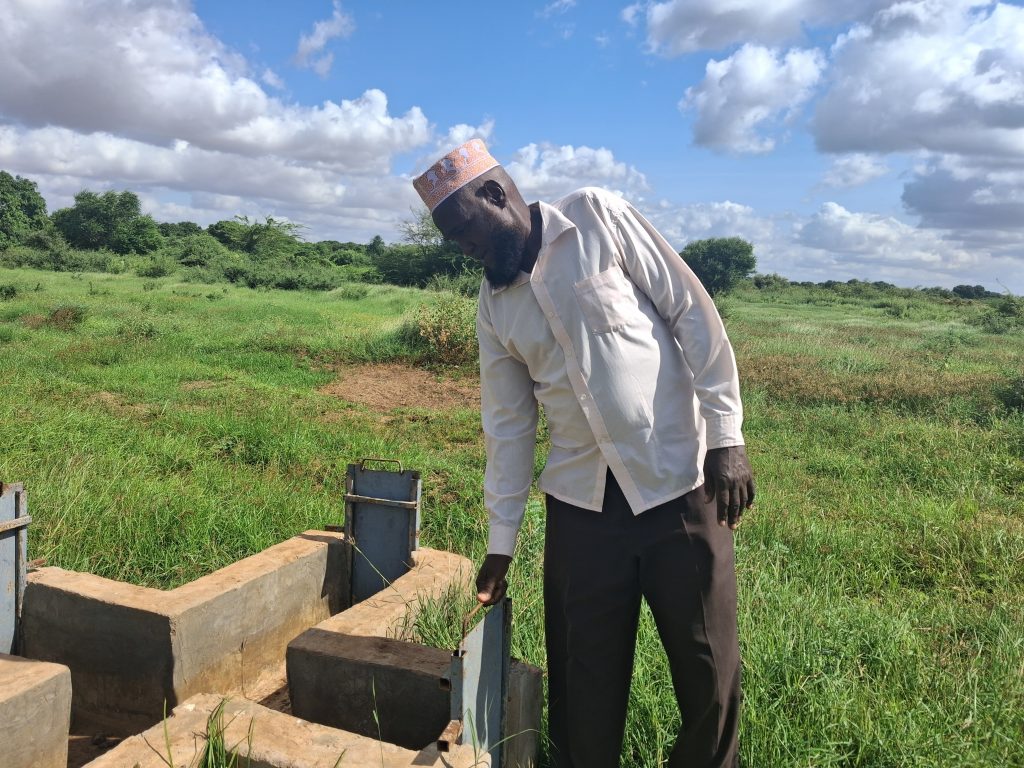
Mukhtar Bule, a farmer, notes that water used to be a big challenge for the farmers. Just irrigating one acre of land would require 5l of petrol weekly to run the generator with a litre costing shs. 240 (US$ 2).
“Since the solar powered pumps were installed, all we have to do is open the taps and gates and the water flows into our farms following the canals,” he says, adding that installation of battery storage systems to enable the solar-powered pump to operate at night and during periods of low sunlight would boost their capacity.
According to the Garissa County PCRA Report, the county has 710,000 hectares of arable land favourable for crop production and fodder propagation. However, of the 32,000 hectares with irrigation potential, only 4,000 is being utilized.
To realize this irrigation potential in a changing climate, the report recommends solar irrigation, use of closed conduit for water conveyance, lining of irrigation canals and drip irrigation.
Under the FLLoCA program already four solar irrigation projects have been completed while three are ongoing in different wards.
They include Badha farm in Saka ward,Leheley farm in Sankuri ward, Wathajir B farm in Nanighi ward, Gubatu farm in Iftin ward, Jarajara irrigation scheme in Jarajara ward and Egan farm in Balambala ward.
Works are underway in Gubatu community farm in Iftin ward to furnish the 75-acre plot with a 1000km piping and 36 solar panels worth 535 watts each. Unlike First farm, they are also set to benefit from beehives and junkao grass seeds. Already, farmers are expectant that the solarization will boost their productivity.
Usmin Abdullahi, a widow and farmer in Gubatu farm, notes that after her generator got spoilt when Tana River burst its banks, she has been left with no option but to manually fetch water for her crops.
“On a daily basis, I have to go two trips to fetch water but I am hopeful that when the project is complete, water will be able to reach us through the canals,” she says. “I will be able to work on my farm comfortably.”
On his part, Ali Ahmed, a farmer, notes that with the availability of the water, their productivity potential will increase. They produce horticultural crops mostly fruits which they supply to markets across Kenya and as far as South Sudan.
“Water insecurity is a big challenge for us. We have even tried to dig our own communal water pan on a slightly higher ground which is far from the river to water our crops but due to prolonged droughts the water pan dried up,” he says.
He notes that though Tana river is prone to bursting its banks and affecting their crops, the project will be useful in reducing the cost of production as most of them usually incur losses due to their equipment including generators being destroyed.
However, he is concerned that the 1000km piping will not be enough for the group. “We are already conflicted on where to lay the pipes and we are requesting for extension of the piping so that all the 75 farmers can benefit,” Ahmed says.