By Sharon Atieno
Global Value Chains (GVC) remain resilient despite rising geopolitical tensions, financial uncertainty, climate-related disruptions and the COVID-19 pandemic, a new report reveals.
The report dubbed, “GVC Development Report 2025: Rewiring GVCs in a Changing Global Economy” is a joint publication of the Asian Development Bank (ADB), the Research Institute for Global Value Chains at the University of International Business and Economics (UIBE), the Institute of Developing Economies – Japan External Trade Organization (IDE-JETRO), the World Economic Forum, and the World Trade Organization (WTO) Secretariat.
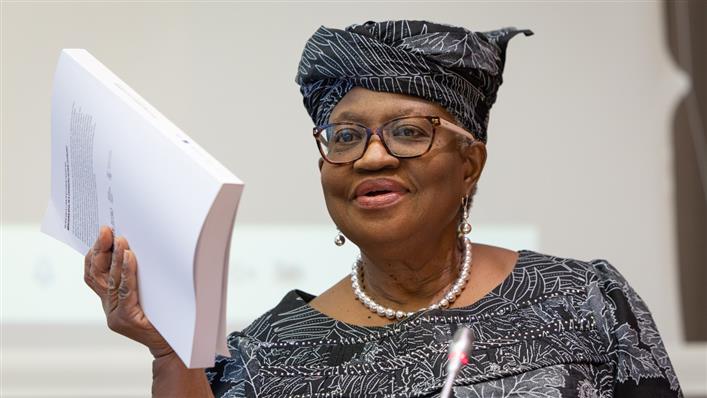
“Globalization is far from over, and global value chains remain indispensable. The share of GVC trade in the global total has declined only marginally from its 2022 peak of 48% to 46.3% last year,” said Dr. Ngozi Okonjo-Iweala, WTO’s Director General at the report’s launch.
“Firms and governments are not retreating from global integration, but reconfiguring it to meet new economic, political, and social priorities.”
According to the report, supply chains are adapting through regionalization, digitalization, and diversification. These adjustments focus on building resilience to shocks, broadening inclusion across economies and firms, and advancing sustainability through technological and policy innovations.
Using updated value-added trade and network measures, the report finds that regional hubs in Asia, Europe, and North America still account for the majority of GVC trade, while emerging nodes in Latin America and Africa remain mainly on the periphery of investment and trade integration compared to the main regional hubs.
It notes that digital trade and data flows have become the connective tissue, allowing networks to adapt without fragmenting. However, these remain key challenges for many least developed and developing countries.
Additionally, policy-driven increases in trade costs and a sharp increase in policy uncertainty are particularly burdensome for marginalized regions that lack an established track record of hosting multinational production.
Dr. Okonjo-Iweala notes that the persistent shortages of trade finance amounting to more than US $1 trillion annually is another challenge.
“Such factors add up and are a major reason why the report finds that the ongoing rewiring of GVCs has mostly benefited countries that were already established as suppliers. If GVCs are to become more deconcentrated, diversified, and resilient, we need to be more creative about overcoming such obstacles,” she said.
Drawing on lessons from the report, Dr. Okonjo-Iweala noted that one solution to overcoming obstacles includes governance cooperation. This was being achieved through more informal, often non-binding, issue-specific frameworks than through traditional bilateral and regional agreements.
“The report identifies more than 180 targeted trade deals with a focus on digital trade and critical minerals signed as of 2024. These arrangements can help build trust and predictability in the new governance landscape,” she said.
Opportunities if structural and policy gaps are addressed
Though the report finds that the distribution of participation in GVCs remains uneven, with Latin America and Africa together accounting for less than five percent of complex manufacturing trade, there are opportunities available.
In Latin America, proximity to North American markets has generated interest in near-shoring, while in Africa, growth in demand for critical minerals and light manufacturing is opening new avenues for inclusion.
“Near-shoring and regional supply networks can broaden participation, but only when supported by complementary domestic policies. Without such reforms, diversification risks producing enclaves with limited spillovers. Regional initiatives such as the African Continental Free Trade Area and the Pacific Alliance can enhance both scale and policy coordination if implementation keeps pace with ambition,” the report notes.
According to the report, the rapid rise of electric vehicles (EVs) is reshaping traditional global automotive supply chains. In 2023, China accounted for 76.9% of global EV production, far exceeding the United States, Germany, and Japan. The three countries have long dominated the internal combustion engine vehicle (ICEV) era.
The heavy reliance of EV batteries on minerals creates new opportunities for resource-rich developing economies to upgrade within the EV supply chain. The extreme concentration of mineral supply, such as cobalt from the Democratic Republic of the Congo and lithium from Chile, also exposes the upstream segment to significant vulnerability. Diversifying sources of critical minerals may therefore emerge as a strategic priority for major battery- and vehicle-producing countries, the report says.