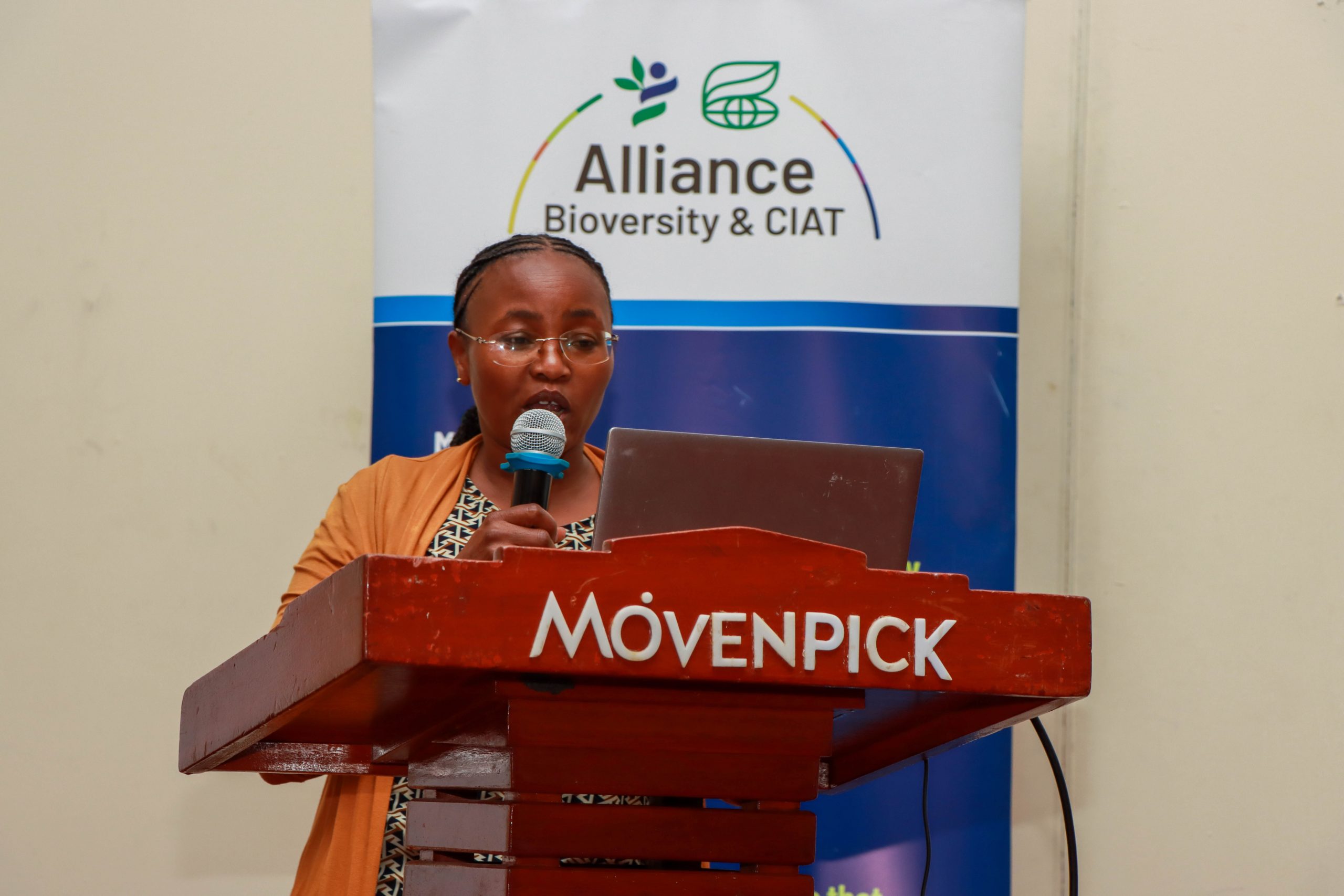
By Milliam Murigi
Millions of Kenyan farmers who rely on basic mobile phones could soon access personalized, climate-smart farming advice through a new artificial intelligence initiative being advanced by the Alliance of Bioversity International and CIAT.
At the heart of the Alliance’s proposal is the development of AI-driven agricultural advisories delivered through USSD technology, allowing farmers to receive tailored guidance using simple handsets.
By downscaling complex geospatial and climate data, the system would generate localized, farm-specific recommendations on planting schedules, input use and climate risks.
“The initiative aims to address a long-standing gap in digital agriculture. While vast amounts of climate and agronomic data are already being generated, much of it remains inaccessible to smallholder farmers who lack smartphones, internet connectivity or digital literacy,” said Anastasia Wahome, research team leader at the Alliance.
Kenya, the Alliance argues, already has much of the foundation needed to make the system work. The Kenya Integrated Agricultural Management Information System (KIAMIS) has digitally registered 6.5 million farmers, creating one of the country’s most comprehensive agricultural databases.
In addition, the Ministry of Agriculture conducts monthly crop monitoring through extension officers operating at county, sub-county and ward levels.
“The data, skills and infrastructure are already in place,” Wahome said. “What we must do now is convert them into practical services that farmers can use. The Alliance brings capabilities in remote sensing, spatial analysis, cloud computing and advanced analytics.”
Through AI-powered USSD services, the Alliance envisions translating sophisticated data into simple, actionable messages that are timely and locally relevant. Farmers would be able to interact with the system by responding to prompts or asking basic questions, without the need for internet-enabled devices.
A key focus of the proposal is language inclusion. Many Kenyan farmers communicate primarily in local languages that are not well supported by existing digital tools. The Alliance is therefore advocating for open and inclusive AI model training to ensure the system can understand and respond in these languages, improving trust and adoption.
The ambition extends beyond individual farmers. The Alliance is pushing for the AI system to be integrated across Kenya’s wider agricultural ecosystem, enabling other sector players to access and use the data.
The goal, the organisation says, is to move from basic advisories to actionable intelligence.
“With accurate and timely information, farmers can reduce production costs, increase yields and improve incomes by applying the right inputs in the right quantities and at the right time. Better climate risk information can also help farmers prepare for shocks such as droughts or delayed rains,” she said.
For agribusinesses, insurers and financial institutions, the data could unlock new opportunities. Insurers could use field-level insights to improve risk assessment and expand coverage, while lenders could extend credit more confidently. Supply chain actors, meanwhile, could benefit from improved yield estimates that support planning for storage, processing and logistics.
“If you know in advance what the harvest is likely to be, you can plan for either a surplus or a shortfall,” Wahome said, noting that predictability is key to supply chain stability and market efficiency.
The organisation is now calling for collaborative partnerships to co-develop, test and scale the AI-on-USSD system. While acknowledging that the initiative will require significant investment in data, testing and refinement, the Alliance maintains that it is both practical and scalable.
As climate change continues to increase uncertainty in agricultural production, the Alliance argues that the future of farming will depend not on generating more data, but on making existing data work for those at the front line.
“By delivering intelligence through the simplest technology available, we believe AI-on-USSD could redefine how digital agriculture reaches the last mile and who it ultimately serves,” she said.