By Sharon Atieno Onyango
Throughout her life, firewood was the only source of fuel that Lucy Wanjiku, a middle-aged woman from Nyandarua county in central Kenya, and her family relied on.
Like other women in African rural households, Wanjiku was tasked with the burden of looking for this precious commodity. A burden she gladly shared with her daughters when they were on school break, sending them to nearby forests. Some as far as 10 km away.
With time, the distance became unbearable and she opted to plant her own trees instead. “I would plant my own trees and cut them for firewood but when I don’t have trees to cut, I spend money buying them. I would spend as much as Kshs. 5000 (US$ 38) for the firewood to reach my home yet it would last just two months,” Wanjiku recalls.
Besides, the constant use of firewood was affecting her health. Her eyes would itch and she would experience constant chest pains from the smoke. She had also started developing excruciating back pains.
The World Health Organization (WHO) notes that approximately one in three people worldwide rely on open fires or inefficient cooking stoves, fuelled by kerosene, coal or biomass such as firewood. This leads to over three million annual premature deaths from household air pollution and spread of non-communicable diseases such as stroke, ischaemic heart disease and chronic obstructive pulmonary disorder (COPD among others.
It is against this background, that the Belem gender action plan (2026-2034) focuses on reducing women’s reliance on harmful cooking fuels like firewood by enhancing clean energy access.

Photo credits: Sharon Atieno
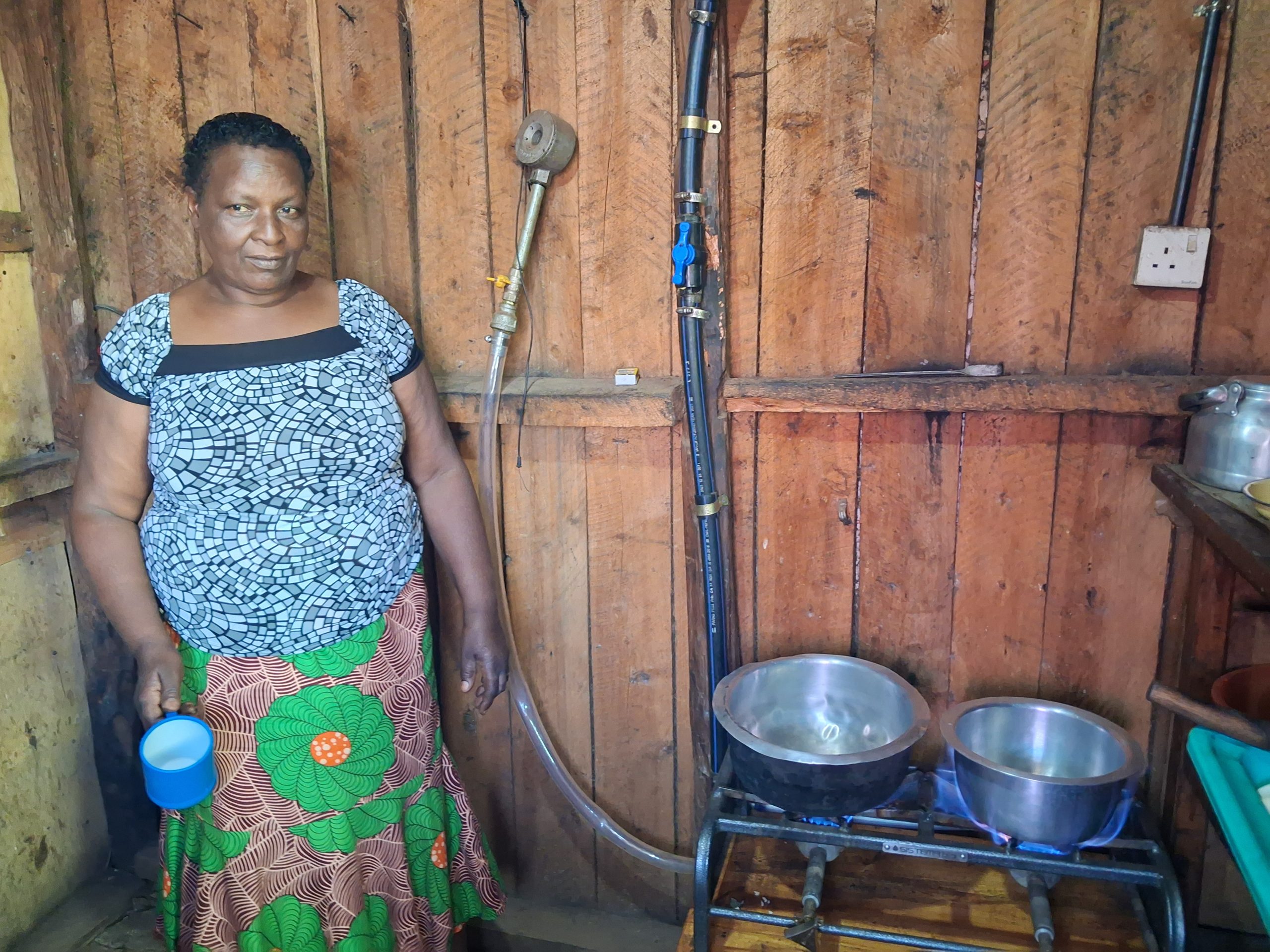
In early 2025, Wanjiku’s household was among the 30 selected to have a biogas plant under the Financing Locally Led Climate Action (FLLoCA) Program. 17 of them have directly benefitted women. Each household biogas plant is 16 cubic metre (m3) with a lifespan of 15 years.
Jointly funded by the Government of Kenya, World Bank, Denmark (DANIDA), Sweden (SIDA), and the German Government, FLLoCA is an innovative initiative designed to build resilience at the local and community levels to combat the impacts of climate change.
The program recognizes that locally led adaptation can be more effective than top-down interventions, as local communities are more aware of the context and what is needed to drive change. It applies principles of meaningful citizen engagement in climate decision making and builds on the foundations and structures set up through Kenya’s devolution efforts.
“We sat down as the climate change ward committee and decided that what can help us as a community, is to reduce deforestation. That is why we resorted to having biogas plants across the ward,” explained Boniface Kimani, Chair climate change ward committee, Gathanji ward.
He notes that the community was overdependent on wood fuel and most had resorted to venturing into the forest to cut trees. This was taking a toll on the rivers and springs nearby.
Through public participation they were able to identify the beneficiaries- majority of whom are women, people with disabilities and the elderly.
According to the World Bank, 90% of program funding from FLLoCA should be spent at county and community levels to ensure that support for climate resilience reaches those most at risk, including women, youth, persons with disabilities, elders, and other traditionally marginalized groups.
Kimani notes that setting up of the biogas plants have led to increased uptake. Already, nine people have independently set up their own plants.
“Many people have become interested. Some women groups who are doing table banking have started saving so that they could establish their own biogas plants,” he adds, noting that the biogas plants have significantly helped to reduce deforestation in the area.

photo credit: Sharon Atieno
Wanjiku has fully recovered since the biogas plant was set up. Smoke is no longer a problem for her. Unlike before, she now has time to do other things like farming.
The biogas has helped her to establish a kitchen garden, where she plants vegetables like cabbages, spinach, kales and carrots. She uses the biofertilizer to grow the plants.
Though the kitchen garden is for her home consumption, Wanjiku sells the surplus and earns some money for her household expenditure. After every two weeks she is assured of Kshs.500 (US$4) from the sale of vegetables.
“This biogas has not only helped our parents, it has helped us too. We would constantly send money for our mother to go to the hospital. Every time, we would be sending money for drugs. Now, she is fine, we no longer send the money,” says Margaret Kamunge, Wanjiku’s daughter.
“Our parents have now found peace, they are not stressed about where the next money to purchase firewood would come from or where they would source that firewood from.”
Cumulatively, FLLoCA program has financed 62 biogas projects in two wards -Gathanji and Kiriita- in Nyandarua county.
With the world moving towards a just transition in cooking ensuring a shift from polluting fuels to sustainable alternatives such as biogas, Teresa Anderson, Actionaid International notes that the just transition should be inclusive involving communities and more so, women who are often invisible, excluded and yet disproportionately affected.
Advocating for approaches like FLLoCA, Anderson said, “Climate action should always put people, livelihoods and concerns at the centre of plans.”