By Sharon Atieno Onyango
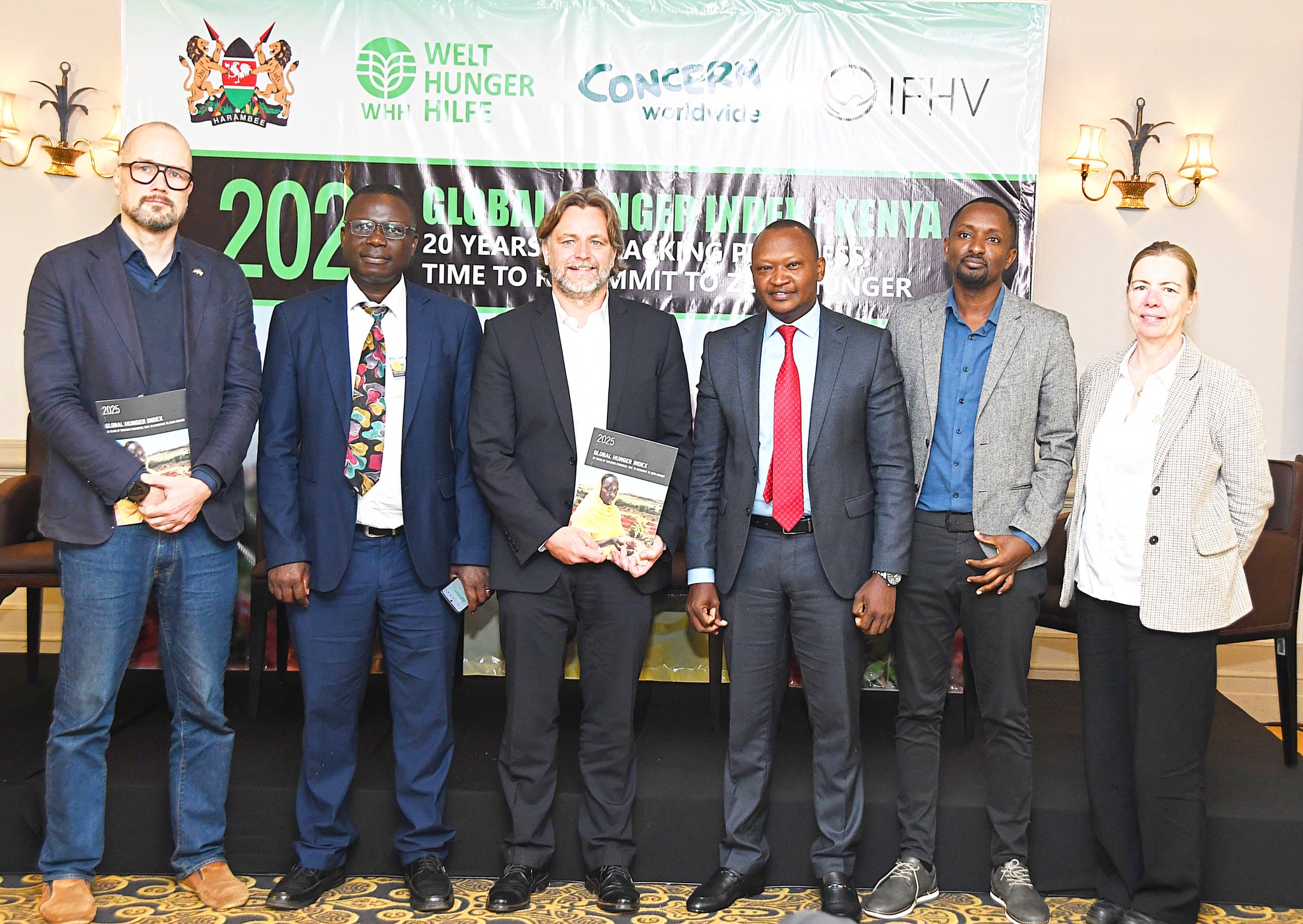
Kenya is becoming a “hungry nation” with one in three people facing hunger, the Global Hunger Index (GHI)- Kenya 2025 report says.
The report by Welt Hunger Hilfe, Concern worldwide and the Institute for International Law of Peace and Armed Conflict (IFHV) found that some 20 million Kenyans are undernourished.
Kenya is ranked 103rd out of 123 countries, with a GHI score of 25.9—an indication of a ‘serious’ level of hunger.
The report finds that children are the most affected with 17.9% being stunted (too short for their age limiting growth, learning ability and future productivity) while 4.5% are wasted (too thin for their height).
Further, hunger is concentrated in arid and semi-arid land (ASAL) counties including Wajir, Turkana, Marsabit and Mandera, coastal regions and urban informal settlements.
Similarly, the Integrated Food Security Phase Classification (IPC) notes that acute food insecurity has affected 23 ASALs and surrounding areas with 3.3 million people classified as food insecure. This includes 400,000 Kenyans in emergency state.
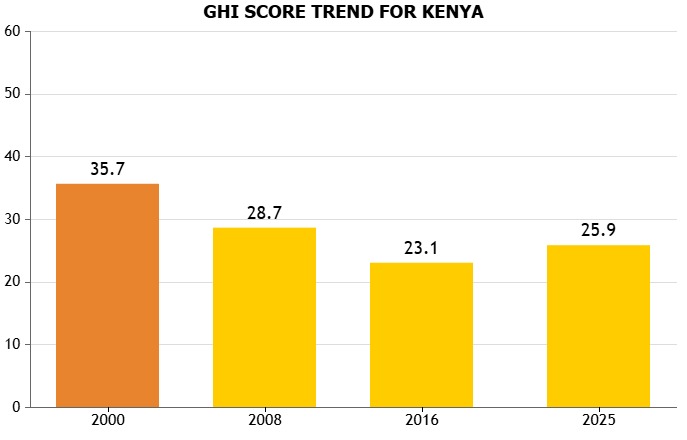
According to Edgar Okoth, Executive Director, SUN CSA, there was a steady decline in hunger from 33.4% to 25.9% between 2006 and 2016. “This was due to better child nutrition outcomes including reduced stunting and decline in under five mortality, and expanded health and nutrition programmes,” he said.
Okoth notes that climate shocks are worsening food insecurity with majority of Kenyan farmers depending on rainfed agriculture. This makes food production highly vulnerable to drought and floods.
The rising public debt is another challenge. It constrains government spending in development thereby affecting the fiscal space for agricultural investment, food systems infrastructure and nutrition programmes, he said.
Moreover, investment in agriculture remains particularly low. Currently, only 1.6% of the national budget is allocated to the sector, despite its significant contribution to the country’s GDP. This underinvestment limits the expansion of essential infrastructure such as irrigation, which is key to stabilizing food production.

Joel Tanui, Irrigation secretary in charge of Land reclamation, climate resilience and irrigation water management, stressed the need to rethink conventional approaches to food security.
With food systems under increasing pressure from climate change, economic disruptions, and geopolitical challenges, he called for renewed commitment, innovation, and strategic investment.
In response, the Kenyan Government has adopted transformative interventions aimed at achieving food security, with irrigation playing a central role. The National Irrigation Sector Investment Plan (NISIP), Tanui explained, is a shift from “business as usual” towards a more inclusive and investment driven approach.
The plan focuses on five critical pathways designed to enhance resilience, boost productivity, and ensure sustainable food production.
The first pathway involves mapping and revitalising all public irrigation schemes to enhance efficiency and productivity while the second focuses on strengthening smallholder irrigation by supporting over 2,500 schemes nationwide, empowering communities to work collectively and improve food production.
The third pathway targets the development of ASALs, which make up approximately 80 percent of Kenya’s landmass. Tanui noted that over reliance on the remaining 20 percent of arable land has placed immense pressure on these areas, making it necessary to unlock the potential of ASAL regions.
As part of this effort, he highlighted the development of 3,000 acres in Mandera under the Daua Irrigation Cluster marking a significant milestone for irrigation in the region.
The fourth pathway focuses on improving farmers’ access to irrigation equipment. Recognizing that many farmers lack the financial capacity to acquire modern equipment, the government is establishing a de-risking fund to support farmers, enabling them to increase productivity and increase their earnings.
Tanui also noted that the government is promoting the utilisation of idle land by opening it up to private investors for agricultural development. This initiative aims to ensure that available land is fully utilised for production, thereby strengthening national food security.