By Milliam Murigi
As Africa pushes to strengthen food security and build climate-resilient systems, stakeholders are calling for a deeper alliance between researchers, policymakers, farmers and the media.
This message rang loud and clear at the 2025 Open Forum on Agricultural Biotechnology in Africa (OFAB), Africa Media Awards, where speakers emphasized that scientific breakthroughs can only transform lives if they are understood, trusted, and adopted by communities.
“We can adopt innovations, we can regulate them but innovation alone is not enough for research to impact people. Communities must trust it. Policymakers must support it. Farmers must feel empowered when they adopt these innovations,” said Margaret Karembu, International Service for the Acquisition of Agri-biotech Applications (ISAAA) Africenter Director.
According to her, journalists play a pivotal role as the interpreters of scientific innovations, translating complex research into stories that are understandable and meaningful to the wider public. By making science relatable and accessible, they help bridge the gap between laboratories and communities, ensuring that innovations are not only discovered but effectively applied to improve lives.
Welcoming guests to the ceremony, Dr. Canisius Kanangire, Executive Director, African Agricultural Technology Foundation (AATF), highlighted that journalists are essential partners in translating complex scientific research into accessible information for farmers, policymakers, and the wider public.
By providing accurate, engaging, and evidence-based reporting, media professionals help communities understand and adopt agricultural innovations, while also holding decision-makers accountable.
Dr. Kanangire stressed that a well-informed public is crucial for building trust in new technologies and fostering sustainable agricultural development across the continent.
“In an era of remarkable scientific progress, innovation alone is insufficient. It must be matched by effective communication, public trust, and inclusive dialogue,” he said.
According to him, journalists should continue investigating emerging trends, challenging conventional narratives, and holding decision-makers accountable. In doing so, they will ensure that the benefits of agricultural biotechnology are realized equitably and sustainably. He extended his gratitude to all journalists and media organizations dedicated to covering agriculture, commending their commitment to accuracy, integrity, and impactful reporting.
Dr. Kanangire revealed that the OFAB program is inspired by global frameworks like the Sustainable Development Goals and the African Union Agenda 2063, and sees biotechnology and communication as powerful tools for empowering smallholder farmers, tackling poverty, and strengthening food security. The program plays a vital role in raising awareness, fostering dialogue among stakeholders, and contributing to evidence-based policymaking.
“The future of agricultural technology in Africa will be written not only in laboratories but also in newsrooms, digital platforms, and community spaces,” he said.
According to Julius Migos, Education Cabinet Secretary, food security has long been a challenge for millions of African households. However, modern biotechnology offers a practical path forward through improved crops such as maize, cowpea, sorghum, rice, potato, banana, and cassava varieties that deliver higher yields, improved nutritional content, and greater resilience to climate variability, helping to strengthen Africa’s food systems.
According to him, biotechnology has the potential to transform agriculture across Africa. The reason is, improved crop varieties can deliver higher yields, enhanced nutritional value, and greater resilience to climate variability. With the right training, knowledge sharing, and support, farmers can adopt these innovations to significantly boost productivity and strengthen food security across the continent.
“South Africa, for instance, has more than doubled average yields through adoption of herbicide-tolerant and insect-resistant GM crops, paired with good agricultural practices. This demonstrates the tangible benefits of innovation when supported by knowledge, training, and communication,” Migos noted.
However, he cautioned against the dangers of misinformation, noting that falsehoods amplified through social media threaten public trust, destabilize communities, and undermine effective decision-making.
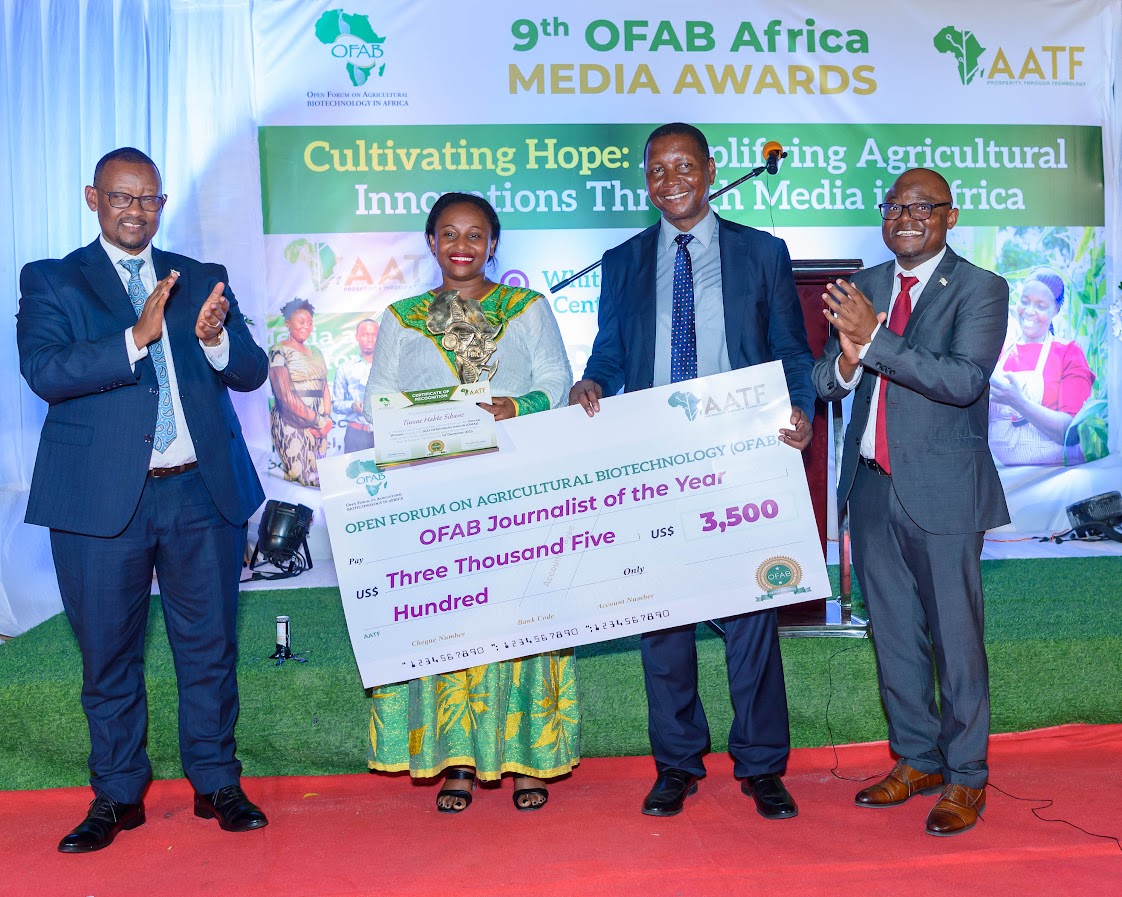
Meanwhile, Jim Israel Mwanda of JLC Times Kenya emerged the overall winner of the OFAB award competition. He was recognized for his exceptional reporting on agricultural biotechnology. His work stood out for its accuracy, depth, and ability to translate complex scientific concepts into engaging and relatable stories for a wide audience.