By Milliam Murigi
Health experts are calling for a major shift in Africa’s malaria response, warning that data alone is not enough to deliver real, lasting impact in the fight against one of the continent’s oldest and most persistent diseases.
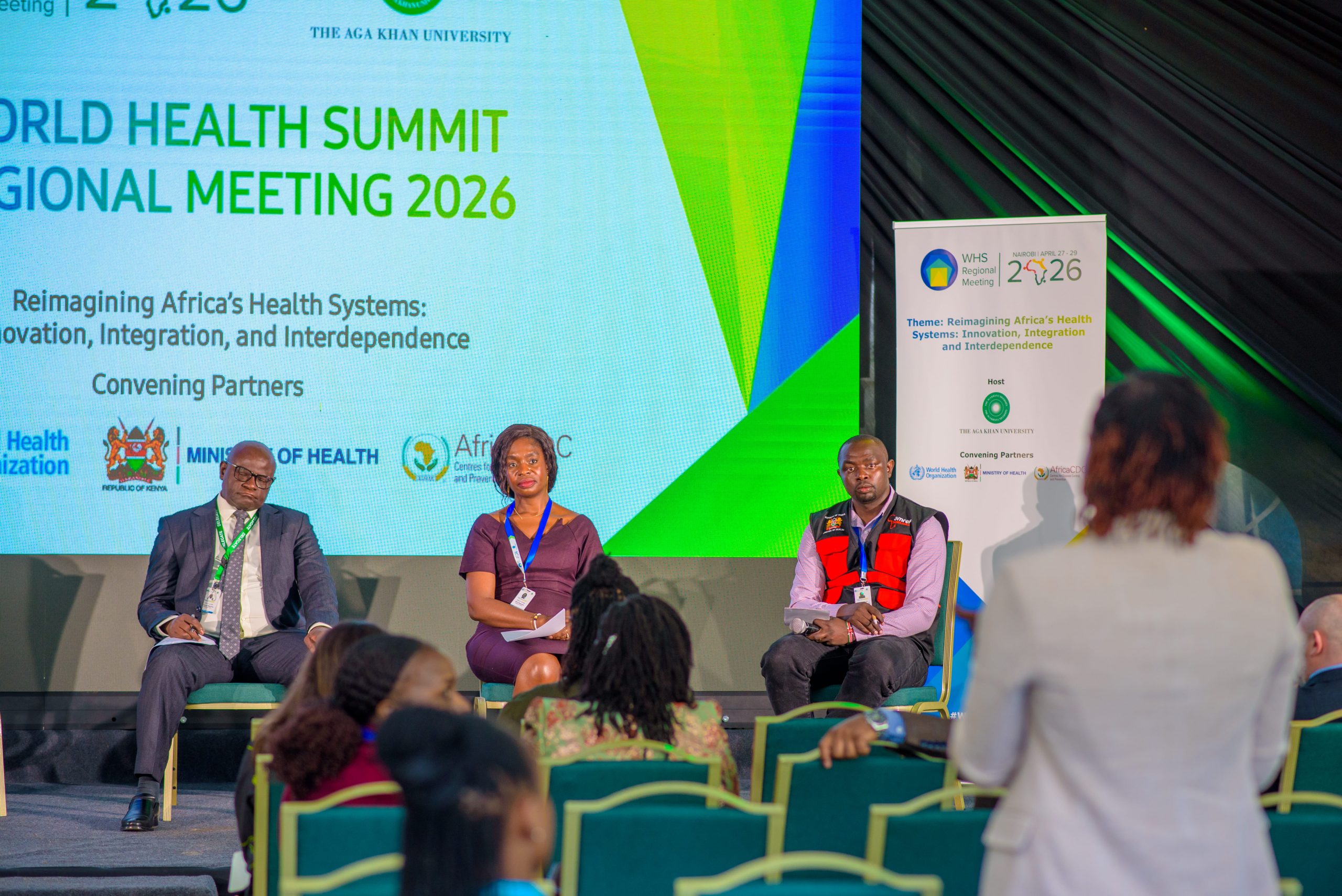
Speaking at the sidelines of the World Health Regional Summit Meeting (WHRSM) 2026 during a high-level session focused on building human research capacity for malaria, scientists, policymakers and global health actors cautioned that over-reliance on statistics such as prevalence rates, incidence figures, and coverage indicators risks distancing research from its ultimate purpose.
“There is a tendency to define problems through numbers rather than through impact,” said Dennis Kinyua, Project Manager Primary Healthcare for Malaria Elimination Project at AMREF.
Stressing that while data is essential, it must not overshadow the human context behind it. “Behind every statistic is a person, a household, and a community whose reality must shape the solution,” he said.
This growing recognition is driving a broader shift in how malaria research is being designed and implemented across Africa. Increasingly, experts are calling for a move away from top-down approaches toward models that prioritize community engagement, local leadership, and co-creation of solutions from the earliest stages of research.
Under this evolving approach, communities are no longer viewed simply as recipients of interventions or sources of data. Instead, they are being positioned as active partners in shaping research priorities, defining problems, and evaluating solutions.
Organisations such as the Medicines for Malaria Venture are at the forefront of promoting this shift. According to Alice Neequaye, through its evolving research and development strategy, MMV is embedding equitable partnership principles across the entire innovation pipeline — from early drug discovery to field implementation.
The organisation’s approach emphasizes shared agenda-setting, co-creation with endemic countries, and long-term investment in local research capacity. The goal is to ensure that new tools and interventions are not only scientifically effective but also feasible, acceptable, and sustainable in the environments where they are most needed.
“Involving communities should not be an afterthought or a choice in research it must be a core principle. Communities are not just sources of data, they are partners in defining problems, generating solutions, and ensuring that research leads to real impact,” said Neequaye.
According to her, equitable partnership goes beyond consultation. It requires shared decision-making power, early involvement of stakeholders, and strengthening of local institutions so that countries are not just implementing solutions developed elsewhere, but actively shaping the research agenda itself.
In practical terms, this shift is already being reflected in ongoing malaria programmes across the continent. In Uganda, for example, health teams observed that while initial uptake of the malaria vaccine was high when delivered through health facilities, completion rates dropped significantly for later doses.
In response, delivery strategies were adapted to include house-to-house follow-ups in hard-to-reach communities, particularly in remote regions such as Karamoja. This change has led to improved uptake of second and third doses, demonstrating how flexible, community-driven approaches can address real-world barriers.
“Such experiences highlight a key lesson, health systems must be designed around the lived realities of communities, rather than expecting communities to adjust to rigid system structures,” said Dr. Godfrey Magumba, East and Southern Africa Programmes Director at Malaria Consortium.
In Kenya, ongoing research efforts in malaria-endemic counties such as Busia and Siaya are focusing on why uptake of key interventions including Intermittent Preventive Treatment in pregnancy (IPTp) and follow-up doses of malaria vaccines remains inconsistent despite strong initial participation.
Researchers are examining a range of factors, including access to health facilities, community perceptions, health system constraints and cultural influences that may affect adherence to treatment schedules. The aim is to generate insights that are not only scientifically robust but also grounded in local context and actionable at policy level.
Another major concern raised during the discussions was the weak feedback loop between researchers and the communities they engage. While communities often participate actively in data collection for studies, they are rarely informed about the outcomes of the research or how their contributions influence policy and programme design.
This gap, participants warned, risks undermining trust and weakening long-term participation in research and public health interventions. Without clear communication of results, communities may feel excluded from the very solutions they helped generate.
“Communities should not only be data providers; they should also be data users,” Kinyua added. “If they contribute to generating knowledge, they must also benefit from understanding what that knowledge means for them.”
Beyond Kenya, experts noted that similar patterns are being observed across other malaria-endemic regions in Africa, particularly in West and Central Africa, where intervention drop-off rates remain a persistent challenge.
Ultimately, experts stressed that the success of malaria elimination efforts will depend not only on breakthroughs in laboratories or global funding commitments, but on how effectively those solutions are translated into everyday realities in villages, households, and health facilities across the continent.
“The future of malaria research in Africa will be defined not just by what is discovered, but by how well those discoveries are shared, adapted and owned by the communities they are meant to serve,” said Magumba.