By Milliam Murigi
Journalists should rethink how they report climate change, because failure to translate complex data into simple, actionable information is deepening inequality and leaving vulnerable communities exposed to disasters.
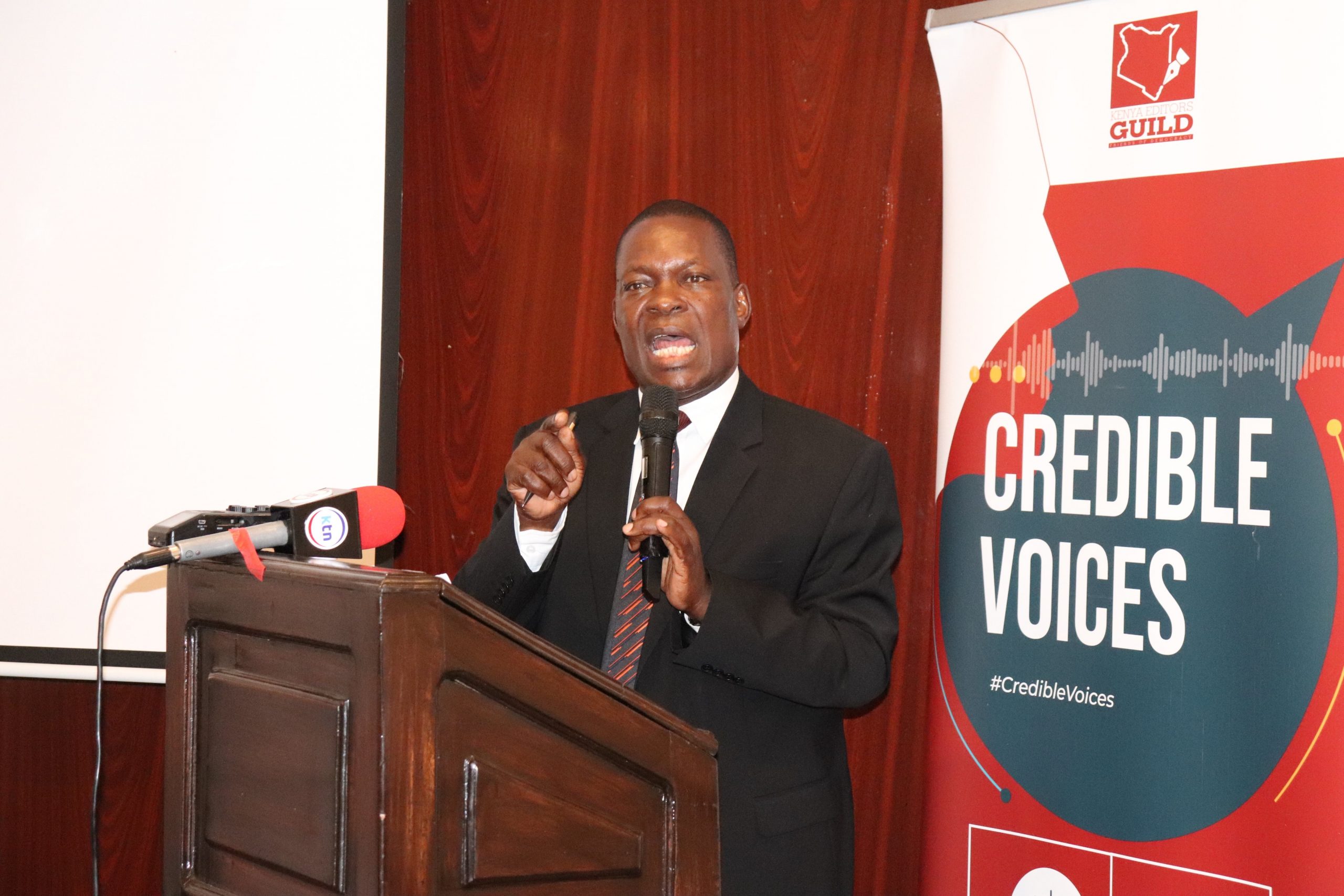
Speaking at a media engagement forum in Kenya’s capital, Nairobi, Peter Odhengo, Financing Locally -Led Climate Action (FLLoCA) program coordinator said that climate information must move beyond technical jargon and reach ordinary people in a way they can understand and act on.
“If you fail to take this information where it is needed, then we are widening the gap between the rich and the poor,” he said. “Climate data, response mechanisms and solutions are not as complicated as we make them. They should not sound like a foreign language.”
He criticised both technical experts and the media for failing to communicate effectively, noting that early warning information often exists but does not reach communities in time to make a difference.
He said that timely communication could save lives and livelihoods. Communities should be informed in advance to move away from danger, protect assets or adapt their practices—such as selling livestock early during drought periods instead of waiting for losses.
“If people are not informed that floods are coming, they will continue with their daily lives unaware. If they are told early, they can act. Communication is the difference between loss and survival,” Odhengo said.
He also took aim at the tendency to prioritise dramatic disaster coverage over preventive reporting, arguing that the media often amplifies tragedy instead of highlighting lives saved through early action.
“One death attracts global attention, but the many lives saved through information go unnoticed. Are we on the right track?” he posed.
At the heart of his message was a call for a shift from top-down storytelling to community-driven narratives. Odhengo urged journalists to focus less on political figures and more on grassroots realities, where the impacts of climate change are most acute.
“In many of your stories, you start with politicians. That needs to change—start with communities,” he said. “The person at the village level is the most important.”
The remarks come against the backdrop of a large-scale climate financing initiative designed to decentralise resources and decision-making. The programme dubbed FLLoCA, is a 10 year national and continental model, seeks to ensure that funding reaches local communities directly rather than being absorbed by intermediaries.
According to him, past climate interventions have largely failed because funds were concentrated among experts and institutions, with minimal trickle-down to those most affected.
“Nearly all the money remained at the top, while very little reached the people on the ground,” Odhengo said. “We want to change that by putting resources, knowledge and power in the hands of communities.”
The initiative’s first phase, running from 2022 to 2026, has mobilised approximately $295 million from a mix of development partners, government contributions and international financing institutions. It targets all counties in Kenya, aiming to build resilience at scale.
He emphasised that climate change requires large, sustained investments, noting that its long-term impacts cannot be addressed through small, fragmented projects.
“Climate change will not wait for one small project here and another there. It requires scale,” he said.
A key component of the programme is improving public understanding of climate concepts, particularly the distinction between mitigation and adaptation—terms he said are often misunderstood even by professionals.
Mitigation, Odhengo explained, refers to reducing greenhouse gas emissions that drive global warming, while adaptation involves adjusting to changing conditions, such as coping with reduced agricultural productivity.
“Adaptation can be as simple as learning to live with less when production declines,” he said, illustrating how households might adjust consumption patterns in response to climate stress.
He also highlighted the importance of climate finance, distinguishing it from broader climate change discussions. Climate finance specifically refers to funds dedicated to supporting interventions that address climate impacts.
Odhengo defended the role of the national treasury in managing such funds, arguing that financial oversight is critical to ensuring accountability and effective distribution.
Journalists, he undescored, hold immense power through their platforms—whether television, print or digital—and must use it to inform, educate and empower citizens.
“You have the power of the pen, the camera and the platform,” Odhengo said. “The question is: will you use it to build resilience, or will you remain silent while communities suffer?”
He urged the media to turn awareness into action by consistently delivering clear, relevant and timely climate information, especially to those at the frontline of its impacts.
“Communication alone can change a lot,” Odhengo said. “But only if it reaches the people who need it most.”