By Milliam Murigi
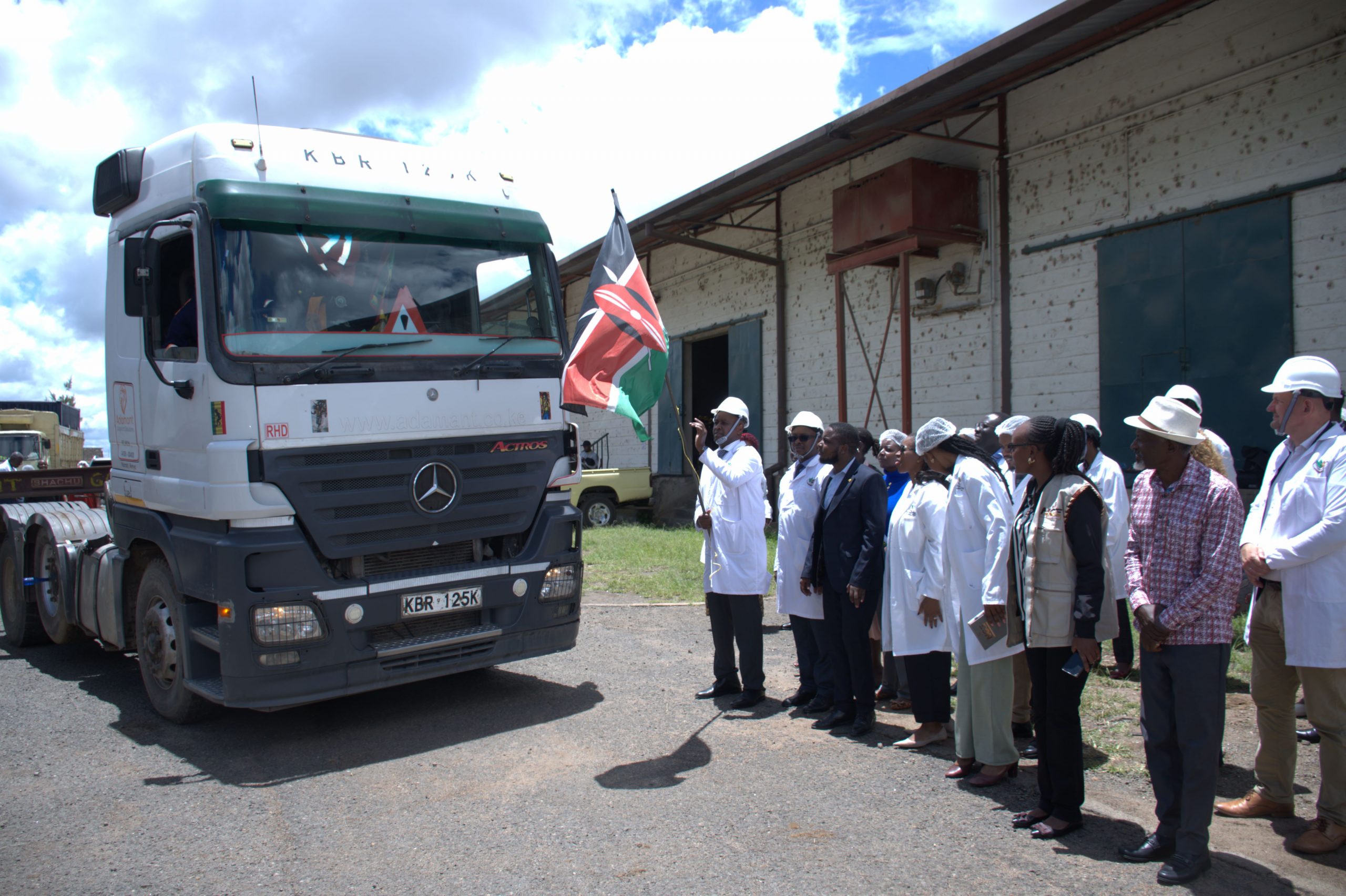
Kenya has flagged off its first consignment of coffee certified as compliant with the European Union Deforestation Regulation (EUDR).
The EUDR aims to curb global deforestation by requiring exporters to prove that commodities such as coffee are not linked to forest degradation.
Destined for Poland, this shipment underscores the government’s commitment to ensuring that Kenyan coffee remains competitive in key international markets, particularly as environmental compliance becomes a non-negotiable requirement for trade.
“The shipment marks a significant milestone for Kenya’s coffee sector. It shows that Kenya is ready and our farmers are ready to produce coffee that meets the environmental, legal and traceability standards required under the EU regulations. We are not prepared to lose the European market when these regulations come into force,” said Patrick Kilemi, Principal Secretary (PS) for the State Department of Cooperatives during the flag-off ceremony.

The shipment consists of 320 bags of coffee, each weighing 60 kilograms, sourced from 13 cooperative societies across the country. This shipment represents progress, coordination and compliance with evolving global standards, said Timothy Mirugi, Managing Director and CEO of the New Kenya Planters Cooperative Union (NKPCU).
It speaks directly to the Government’s commitment to revitalizing the coffee sub-sector, enhancing farmer incomes, and strengthening Kenya’s position in global markets. It also reflects our alignment with international sustainability standards, particularly in the context of climate action and responsible trade.
“Today, we send a clear message to the world, Kenya is ready to meet global regulatory requirements, provide fully traceable and deforestation-free coffee and compete at the highest level while safeguarding the interests of our farmers,” said Mirugi.
The EUDR is set to come into force on 1 January 2027, giving countries and exporters’ time to prepare. However, many countries have raised concerns about the complexity of compliance especially around geo-referencing farms but Kenya has taken a science-driven approach to meet the standards.
Kevin Onyango, Senior Research Associate at the Alliance of Bioversity International and CIAT, described the shipment as the result of a year-long collaborative effort across the coffee value chain.
“We brought together farmers, cooperatives, regulators, and market actors to answer a shared question on how to respond to EUDR requirements in a way that is credible, practical and inclusive,” said Onyango.
The initiative, co-convened with the Nairobi Coffee Exchange and the Kenya Coffee Platform, created a neutral space for consensus-building on deforestation risk assessment and sustainability definitions. At the core of the process was the use of open science and data-driven methods.
Working with the Kenya Planters Cooperative Union, researchers analyzed farm-level data shared with farmers’ consent to verify compliance, applying publicly available tools to assess deforestation risk. Onyango confirmed that the coffee in the exported container posed “very low to no risk.”
“We refer to this shipment as EUDR-ready but the final compliance determinations rest with regulators. But based on current research and methods, it should meet the requirements,” said Onyango.
The process also addressed concerns about data ownership, ensuring farmers retained control over their information while enabling traceability and transparency. According to Onyango, the key takeaway is that the tools already exist; the technologies are not exotic, and the real work lies in collaboration.
The successful export according to PS Kilemi has restored confidence among farmers, many of whom had feared exclusion from European markets due to the new rules. It also reflects a strategic shift in Kenya’s coffee trade. By exporting directly to Poland rather than through traditional intermediaries, the country seeks to reduce reliance on brokers and secure better returns for farmers.
“We are also exploring expansion into markets including China, the Middle East and Australia, as part of broader efforts to grow the sector’s contribution to the economy. Under Kenya’s coffee revitalization programme, the country aims to boost production by improving yields and expanding cultivation into regions such as Western Kenya and the North Rift, with ambitions to become second only to Ethiopia in Africa,” he said.